• About

Succeed in Football

~ The daily blog written by ITL's Neil Stratton

Succeed in Football

Monthly Archives: July 2015

A Less Hot Career Option?

30 Thursday Jul 2015

Posted by itlneil in Agents

≈ Leave a comment

Tags

NFL agent

If you follow me on Twitter, you know the number of would-be NFLPA contract advisors was down a bit this year, off by maybe 50-75 candidates (based on the number of people taking the agent exam this year). I have a number of thoughts about this.

  • The fact that the numbers are off a bit from the past 2-3 years isn’t a big deal. Recently, having about 300 in the room was pretty routine, but this was easy to explain. The new runner rule, which outlawed any contact between a prospect and an agent’s non-certified representative, prompted many agencies to certify any and all of its employees.
  • Then again, it’s possible there are fewer people with a passion to work with players, for a couple reasons. One, it’s been a long, long time since ‘Jerry Maguire’ was in theaters. Of course, maybe ‘Ballers’ will reignite that spark. Two, I think the move to analytics has probably attracted a lot of people who might previously have seen agent certification as their surest route to fulfilling work.
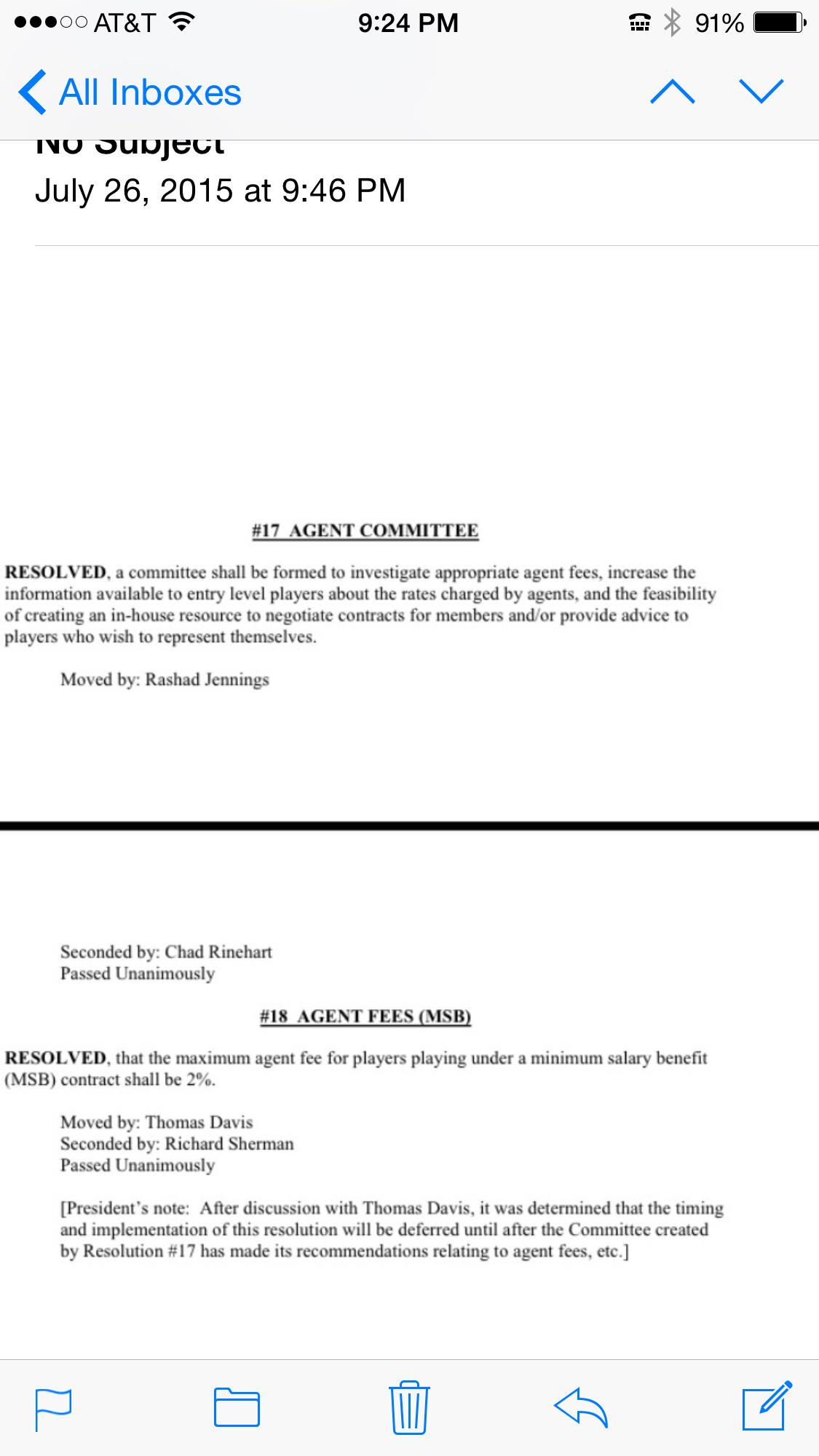
  • If more people really understood what was in store for them once they became full-time contract advisors, maybe fewer really would get certified. I mean, check this out. It’s a copy of the minutes from the last players association meeting, and it shows that the players are actually considering dropping the standard commission on contracts from three to two percent. If this happens, it will be nearly impossible for new agents to recover their expenses.
  • The NFLPA is a very good thing for players in some ways. It has been a leader in demanding certification for agents, and ensuring that they actually know what they’re doing with regards to the Collective Bargaining Agreement. This is very important. On the other hand, the union regularly runs over the agents who are supposed to be advocating for the players. To wit: the NFLPA is assisting a top NFL player who’s trying to negotiate his own deal, and it very rarely intervenes when an agent tries to poach another agent’s clients.
  • When there’s no justice and no reason to have a presumption of fair play, it’s pretty demoralizing. The upside for the union is that so few people know how this business really works. So many young, idealistic people get into this game thinking the players are the victims; it’s a narrative that’s advanced by the media and people around the game. What you find out quickly, however, is that most of the people on the ground floor of the business — the less-established agents, trainers and financial planners who are trying to earn a foothold in football — are actually pretty earnest and fair-minded. Not all of them, mind you, but most of the ones I’ve met.

This is one reason why I’m pretty enthusiastic about ‘The Agent,’ which kicks off in about a week and a half (Tuesday, Aug. 11, on the Esquire Network). It’s a chance to see contract advisors conducting business in jeans and collared shirts rather than three-piece suits or leather jackets. It’s a chance to see them operating alone and uncertain, instead of talking fast and with total confidence.

I hope, for better or worse, it’s a great learning tool for anyone interested in the business side of the game. I think it will be.

WSW: Why Character Matters

29 Wednesday Jul 2015

Posted by itlneil in ITL, Scouts

≈ Leave a comment

Tags

ITL, NFL Scouting

The last seven days have been very eventful for a now-former Saints player, Junior Galette. The DE/OLB was released by New Orleans two days ago in the wake of a series of events (some reported, some not so much) that were too much to bear for head coach Sean Payton.

It’s easy to look at the Saints as victims here. After all, they had signed Galette to a hefty contract about a year ago on the heels of a big 2014 season (his ‘arrival’ was even saluted with a locker full of basketballs, courtesy of his teammates). They believed in him. They gave him his shot as an undrafted free agent, patiently coached him up and watched him flourish, then rewarded him.

The truth is that they took a calculated risk, and it’s one of the reasons they self-destructed last season. The Saints moved a lot of very talented players since last season, and the only explanation could be that they made the locker room a dysfunctional place. Galette has to have been part of that problem, but it’s not like Payton and Co. shouldn’t have expected this. His domestic violence incident just added fuel to the fire.

Galette got run out of Temple for a number of reasons, but there were whispers that one of them was that he punched a fan on the way off the field. Of course, everyone makes mistakes, but the point is that Galette didn’t seem to learn from them.

Leading up to the 2010 NFL draft, I heard stories about his behavior. Mind you, the one time you have to stay clean and sober-minded is during the 4-5 months before the draft, when every eye is on you. He couldn’t pull it off. I’m told he required daily 24-hour supervision during his pre-combine training, almost as if he were a toddler. In fact, one day when he was left unsupervised that winter, the hotel staff had to call his advisors, alarmed because he had disappeared, leaving his room strewn with drug paraphernalia.

Before his release, the Saints were a team with an unhealthy cap situation. Because they had to cut Galette so early in his deal, the team is in serious peril. Here’s how J.I. Halsell of NFLContractMetrics.com described what the team faces.

“When the Saints extended Galette’s contract in 2014, they guaranteed the 2015 12.5M roster bonus, meaning there was no way for them to get out of the 12.5M obligation. The only thing they could do to soften the cap blow was to convert it to a signing bonus in March of this year (which they did). From a cash payment standpoint, their hands were tied. The takeaway is that things obviously drastically changed from September 2014 to now. In Sept 2014, they felt comfortable committing to Galette through at least the 2015 season, but as we head towards the 2015 season, he’s now no longer a part of the team.”

At our 2015 ITL Seminar at the combine, former Bears GM Phil Emery said that every scout who wants to disallow a potential draft pick must ask himself the question, would you rather play with him or against him? That may be true, but there’s a major risk associated with adding players that have so thoroughly shown that they are a character risk.


NFLPA Exam Reaction

27 Monday Jul 2015

Posted by itlneil in ITL

≈ Leave a comment

Tags

NFLPA Exam

I spent most of Friday afternoon and Saturday gathering feedback from several ITL clients who took the NFLPA certification exam last week in Washington, D.C. Here are several of the reactions I got to the test, provided with minimal editing:

  • I thought I did great. I just could see the tricks in the questions . . . and understood how to answer.
  • The test questions . . . were totally different and brutal. Some of the wording on the questions on the test was ridiculous.  In fact question 60 about a player leaving the squad, I don’t believe the answer was even one of the 4 on the test.
  • No clue how it went. Had to rush on 3 to 5. And was stumped on a couple. Probably gave up a few easy ones due to time. But I’m talking with (a fellow test-taker), and seems like I did well on the tricky language ones. First hour was really good. Hour 2 was where I fell behind, but mostly the hour-and-a-half to 2 hour slot is where I fell (behind) a little. Then hour 3 was pretty good on being able to get to the end and answer the rest. Ones where I screwed up is where I left a few blank, then guessed, then a couple where I left it at one or the other. I feel like I really screwed up on giving some questions away. There really only was a few where I wasn’t sure. The rest that I missed was just time.  I guess no one was walking out of there confident. Eight weeks is just too long. One minute I do feel fine, ‘cause I remember it can be around 18 questions you can get wrong, and I felt good about the ones I actually spent the time to answer. Thanks though, definitely helped to have guidance from (the ITL practice exam).
  • It was really hard but I think I did fine. It was difficult, not gonna lie. But I was prepared.
  • It was tough. I think I passed but wish I was more confident. . . I didn’t study much. Hope that doesn’t come back to bite me in the ass. . . also some questions were poorly worded, in my opinion. Two of them in particular that I can argue back and forth between two answers. I’m sure I did fine, given the (70-75 percent) pass rate.
  • Thought it wasn’t bad. Didn’t know a few questions though, probably 4-5.
  • I think it went well. Then again, it’s hard to know. The exam was long so not much time to waste on questions. Since it’s a scaled passing grade, hard to know how it went. Happy it’s over, though. The (ITL practice exam) was helpful. I think the best thing would be more questions to practice managing the time. I finished the 60 questions with 20 minutes left in the exam, so I had time to review my answers a bit. Not all, but two-thirds, I would say.
  • It was challenging. You definitely had to pay close attention to the wording to find out exactly what the question was asking, especially since some questions had full sentences that weren’t needed in finding the answer. Would love to know how everyone scored. So many different opinions (on how the test went for everyone). The practice exam was definitely helpful. Saw similar questions on the exam. Not all the exact final questions but the concepts and thought process to the answer was the same. I feel pretty confident overall.
  • Tricky, but I think I did well. Looking around the room, I’d expect (a variety of opinions on the test). Wide range of personalities.
  • I feel OK about it but it wasn’t easy. Finished with 12 minutes left to spare. Hopefully the curve is low.
  • Test was challenging. Thought I did pretty well though. Had answers that made sense on all questions. I either aced it or bombed without knowing. I’d say 80-90 % of people stayed the whole three hours. Heard more than a couple say they ran out of time and had to guess on the last 5-10 questions. It was about what I expected. They still gave clear indication on some questions that would be asked in the lectures. But not all.
  • It was (hard), but (the ITL) practice test helped a lot. I’d say a solid 10 of your questions in different fact patterns were on there.
  • Extremely (hard). Lots of questions on what advisors would do in certain situations. I was blown away.
  • Harder than the practice test for sure, but I (felt) pretty good walking out. . . . Hopefully the results come back like that but I feel like they went over just about everything so as long as you were diligent in the seminar almost everything was covered. There might have been three that they didn’t cover to see if you could find it yourself, but no more than that.
  • The exam went well. Some tricky questions but I felt prepared because of the (ITL practice) exam questions. It was tricky, but there were parts where I just breezed.
  • Test was challenging but fair. Your practice test is very helpful and puts one in the right state of mind.
  • Test was way harder than I anticipated. They did a terrible job of going over benefits this morning – had a really young guy who went really fast. There was a workman’s comp question that really stumped me. They went so fast this morning that we were able to start the test an hour and a half earlier than planned.
  • Bro, I killed that test. Thanks for everything, man.
  • It was pretty easy (I say that knowing I could fail). Was done with about 45 minutes (left) and spent the next 30 rechecking answers. Either way, thanks for all the help.

Three Points on ‘The Agent’

23 Thursday Jul 2015

Posted by itlneil in Agents

≈ Leave a comment

Tags

NFL agent

I just watched the first edition of ‘The Agent,’ which follows four NFLPA contract advisors through the run-up to the 2015 NFL draft. It kicks off Aug. 11 on the Esquire Network at 10 p.m. ET/9 p.m. CT. Here are three thoughts.

  • Think of every show that’s ever purported to show the life of a sports agent. Let’s see. You’ve got ‘Jerry Maguire,’ of course, and ‘Arliss.’ You’ve got ‘Entourage,’ and now ‘Ballers’ (boy, HBO sure loves agent stuff). You’ve got Morgan Spurlock’s documentary, ‘The Dotted Line.’ You’ve got ‘Super Agent,’ which aired in 2005. I’ve never seen ‘Ballers,’ and I’ve only seen bits and pieces of ‘Maguire’ (which really surprises some people). I’ve seen several episodes of ‘Arliss,’ though it was more of a screwball portrayal and not really to be taken seriously. I saw one episode of ‘Super Agent’ and nearly vomited. I’ve seen one episode, I think, of ‘Entourage.’ I saw Spurlock’s documentary several times. Anyway, ‘The Agent’ puts them all to shame (though I don’t grade ‘The Dotted Line,’ which was very good, alongside the rest of them). If you read this blog, you are not gonna want to miss it. In fact, set the DVR right now. I’ll wait.
  • I’m proud to say the three people I’m closest to the in the show all come off as real people. No putting on airs or strutting around in sunglasses that cover their entire face. Two of the agents featured spend their first minutes on air riding in limos, putting on designer suits and the like. Bright lights, big city stuff. But two others, Ed Wasielewski of EMG Sports and Peter Schaffer of Authentic Athletix, are just regular guys, dressed in regular clothes. If you sat next to them on a plane, you’d never know they were agents. Meanwhile, Rick Roberts, who handles personnel for Pro Source Sports, is every bit the man on the show that he is in real life: knowledgeable, approachable, likeable and down to earth. All three of my friends are as authentic on the screen as they are in real life. You’ll enjoy getting to know them.
  • I know I come across as a party pooper when I’m always preaching how much work agents do, but it’s true. You get to see it in this show. I’m sure there will be plenty of private planes and invitation-only parties in later broadcasts, but the first edition featured a lot of nights spent alone in hotel rooms and long, lonely car rides. There’s one scene that captures the life of an agent perfectly. An agent has been courting a player for months when, out of nowhere, he’s asked to meet the player’s ‘mentor.’ The mentor wants to meet the agent in the next 24 hours, which means a cross-country flight on a ticket bought a few hours before wheels-up. The agent sits in the darkness of his car, alone and exhausted, as he ponders whether or not it’s worth the energy and expense to drop everything and meet with this person he doesn’t know, hoping it gives him an edge. That, right there, is the essence of this business.

We’re about a month from the second episode, and I can’t wait. If you are interested in the football business and really want to see it, warts and all, you’re going to want to watch every episode. Check it out.

WSW: Getting Creative

22 Wednesday Jul 2015

Posted by itlneil in Scouts

≈ Leave a comment

Tags

J.I. Halsell, NFL Scouting

I don’t talk about it much, but I think one of the themes of this blog is that to be successful in this business, you must be ‘your own man.’ You must be creative. You must be willing to go your own way.

J.I. Halsell of NFL Contract Metrics had an instance during his time with the Washington Redskins that his ability to think a little differently was a key asset.

The team had just drafted LSU SS LaRon Landry as the sixth pick in 2007. Landry would give the ‘Skins a pair of aces at the safety position as he teamed with FS Sean Taylor, the team’s athletic superstar at the back of the secondary. The problem was that though Landry, like Taylor, was an athletic freak (4.35 40 at the combine), the position where he’d be playing would not lend itself to easy incentives. Box safeties don’t rack up sacks and interceptions; they’re more like linebackers whose value is in stopping the run and intimidating at the line of scrimmage. That meant J.I. would have to come up with other ways to compensate him without the usual incentives.

“(Landry was) not a ball-hawking free safety like most first-round safeties,” J.I. said. “He was a box safety that went in top 10. Back then, there was a lot more leeway about how (a contract) was structured. There were not many box safeties in the top 10. How do you create an incentive package for a guy that wouldn’t get a lot of turnovers and interceptions? How do you judge his productivity, while also mitigating the team’s downside so that the team didn’t have a lot of risk?”

He said the ability to think outside the box (no pun intended) is key whatever side of the table you’re on.

“Once you get to a team, or to an agency, you have to think creatively so you’re compensating the player or the team accordingly. LaRon was just as much a freak (as Taylor) in terms of his testing at the combine. He didn’t have the length, but he could run. We had two freak athletes at safety, and how do we compensate these guys?”

J.I. was able to craft a deal that had the right mix of base salary and incentives that were enticing to Landry and his agency, New York City-based Lagardere Unlimited, and the team was able to get him to camp on time, signing him shortly before camp started in late July.

I think this is important if you want to work in this business because there’s no real formula for success. You can try to storm the gates of NFL teams in an attempt to be a scout, or you can save your pennies and take a shot at being an agent, but if you’re creative, you might be able to find your own way to the football heights.


How J.I. Got His Start

21 Tuesday Jul 2015

Posted by itlneil in ITL

≈ Leave a comment

Tags

J.I. Halsell, NFL Contract Metrics

Before we go further with J.I. Halsell’s place in the football business and his new website, NFL Contract Metrics, I wanted to let him tell the story of how he got his foot in the football door. I’ll let him tell it, then have a few comments to follow:

“When I was in my first semester at Seton Hall (where I was pursuing my MBA), I worked in the sports information office, and the assistant SID there, his good friend from his time as an undergrad worked with the NFL’s Management Council. I’m a stats guy, so working in sports information was great because I worked with the basketball team the entire semester.

“So the assistant SID noticed my work ethic, and his buddy (with the Management Council) was looking for an intern. I reached out on a Friday, interviewed on Monday, and got the offer to intern on Tuesday. I turned a three-month internship over the summer into two years with the league.

“It was a paid internship, but it’s New York City, which is super-expensive. But it was a paid internship. Harold Henderson was head of the Management Council at the time, and it was important to him that the interns on the Management Council and the legal clerks on the labor law side, the internships were paid. It didn’t pay a lot, but it was better than nothing.

“I lived in North Jersey, right across from Manhattan, me and one of the other interns. We all kind of lived in a house, and I paid a ton of money to live in a room that ‘s about the size of a walk-in closet, but it was great. My son’s godfather, I met him there, and it was a good time in my life. You’re in your mid-20s, you’re in New York City, you’re working in sports, and it was a fun time in life and transformational in the information I was acquiring.”

Here are a few thoughts on J.I.’s climb:

  • J.I. was working on his post-graduate degree, but still willing to work for free on a job that had long hours and not a lot of glory. Not everyone is willing to do that.
  • What’s more, he was working in basketball, but he was still able to parlay it into football. Get your foot in the door with one sport, and sometimes it takes you into another one.
  • Seton Hall isn’t exactly known as a football factory, but because he put himself in position to succeed, he happened to find a guy who knew another guy. He made his own breaks.
  • J.I. probably wondered how he’d make his situation work, given the low pay and the fact that he most likely already had a life plan mapped out. But he took a risk and it paid off big.
  • There were probably friends J.I. had from high school, and even from college, who were already out in the world, starting to make real money when he was working for peanuts at the Management Council with no guarantees and no promises. But because he went for it, it paid off. It’s hard not to root for a person like that.

Tomorrow, we’ll talk about his experiences with the ‘Skins for WSW.

Introducing my friend, J.I.

20 Monday Jul 2015

Posted by itlneil in Agents

≈ Leave a comment

Tags

J.I. Halsell, NFL agent

This week, I’ll be talking to J.I. Halsell in this space. J.I. is an interesting guy for a lot of reasons. One reason is that he’s worked on both the NFL side, as part of the management council and as the Redskins’ cap guru, and on the agent side, as part of Chicago-based Priority Sports, one of the top firms in the business.

What’s also interesting to me is that he walked away from the agent side of the business voluntarily. He got a player drafted early in his two years with Priority, and had more than one active client in the league when he cashed in his chips. Most folks who had a slot with a big firm and were starting to make their way in the biz would never give it up to move back to his West Coast roots, nearer his family.

The final thing that’s cool about J.I. is that he is very entrepreneurial. Though he’s worked with an NFL team and he’s worked with a big firm, he’s willing to bet on himself. His new site is NFL Contract Metrics, which breaks down the effect the cap has on all 32 NFL teams in a way that anyone can understand. It’s a subscription-based website, like ITL, but it’s very reasonable at $24.99 for a year, and I guarantee that if you sign up, you’ll learn something.

The best feature of the site is where J.I. takes all teams’ depth charts and includes their cap numbers as well as a host of other numbers. It really brings out these players’ impact on the team’s salary structure in a way I don’t know that anyone else does. It’s the report that one NFL team’s GM is already raving about, and rightly so.

We’ll tell his story of landing an internship with the NFL Management Council later this week, but there’s one thing he said related to his work there that really resonated with me. “I knew that getting exposed to the cap was a unique skillset because you couldn’t take a class and learn that. In one way, I did kind of luck up on it, but in another way, luck brought me to a field that was right up my alley.”

If you want to be a success in football, and you’re determined to be an agent or a scout or any other traditional field, more power to you. However, be open to seeing fields that maybe aren’t already well-trodden, as J.I. did.

More on J.I. and his thoughts on the football business later this week.


Is Being an Agent Easier for Lawyers?

16 Thursday Jul 2015

Posted by itlneil in Agents

≈ Leave a comment

Tags

NFL agent

This is a question I get all the time, and since we’re a week away from 300 people descending on Washington, D.C., to take the 2015 NFLPA contract advisors exam, I thought I’d try to answer that question today.

When it comes to the exam next week, it seems like it’s much easier for attorneys, especially those who’ve had a chance to take the ITL practice exam. Here are a few statements from agents who took the NFLPA exam after the bar exam, taken from our free newsletter:

  • “I don’t want to say it was easy, but after taking the bar, I had confidence I’d pass it because of my law background. It was straightforward.”
  • “I thought it was pretty straightforward and easy.”
  • “If you put the time in and have a reasonable amount of intelligence, you shouldn’t really worry about it.”

Here are a few from non-lawyers:

  • “I studied for three-and-a-half or four months, and being self-employed, I could spend 2-3 hours a day studying. After taking the test, I thank God I did that.”
  • “The info on the exam can make you intimidated, but if you listen to the seminar and take good notes, it’s doable.”
  • “I thought it was fair but tough. You definitely have to know your stuff. I. . . actually studied my stuff on my honeymoon.”

I also think players get a feeling of confidence when they find out their agent is also an attorney, so there’s a benefit there. And with litigation a constant possibility in this business, it comes in handy.

On the other hand, I think attorneys often ball back on their knowledge of the law as their salvation, and this is especially true of lawyers in a big firm. And they should — the law is an intricate and complicated thing, and it takes a smart person to help folks clear legal hurdles. If you spend most of your time wrangling with judges and arguing why a person is guilty/not guilty, you might put your faith in your knowledge of the collective bargaining agreement. Unfortunately, that’s not going to get you very far in this business.

How well you recruit is about 90 percent of your grade as a young agent. That’s something a lot of new agents don’t realize (especially established, high-earning attorneys). I spend a lot of time on the phone with new agents, and usually, I can get a good handle on whether or not that person is going to be successful. Lots of new contract advisors find out they passed the test in September, then don’t know where to start. Often, they punt their first year in the business as a result.

I know the lion’s share of people reading this blog aren’t attorneys and not all want to be agents, but plenty are. Some of them might be in D.C. next week, so I thought this was something to address. More next week.

WSW: The Art of the Interview

15 Wednesday Jul 2015

Posted by itlneil in Scouts

≈ Leave a comment

Tags

NFL Scouting

The process of pulling useable information out of draft prospects fascinates me. As the entire draft process has become more refined and former scouts and general managers are being hired to prepare draft prospects for their interviews at the combine, it’s tougher to get unvarnished truth out of the interview process. I asked retired NFL scout Oscar Lofton, who was with the 49ers for the better part of two decades evaluating talent. Here’s another interesting segment from Oscar on our YouTube channel, and here’s the entire interview. Enjoy.

“I treated (players I interviewed) like I was one of the coaches, you know? (Like) I was going to coach them myself, and I would always try to get on their good side. I’d try to say, ‘hey, when you played Notre Dame, man, you had the quarterback, you know, he’s peeking over here, like “here he comes again!”’ You know, try to give the guy some confidence so he’ll open up a little to you, and (I would) talk well about his playing time and where (I thought he would be) going . . . in the draft. You know, ‘hey, there’s a lot of buzz about you, I need to find out about this,’ (and) you know, ‘when you come to our place (if we draft you), what are you going to bring?’

“You know, something positive to get him to come out a little bit. ‘What are you going to bring to the 49ers? When you come and you line up in the first exhibition game, or the first practice against our All-Pro left tackle, or whoever, you’re covering the best receiver, we got Jerry Rice, what do you bring to the table, what are you going to do?’ Generally they take that as a little bit of a challenge, and they’re going to speak and say, ‘well, you know, maybe he’s a great receiver, but I’m going to make him work through his routes, and then I’m going to try to strip him of the ball,’ and I’m not going to try to embarrass him.

“If he’s a receiver, you say, you know, ‘we’re going to put (former 49ers cornerback) Nate Clements on you. What are you going to do to him?’ ‘Well, you know, shake his jockstrap or whatever. You know, something cocky. Maybe you start out, if the kid’s a receiver . . . say, ‘look I used to coach receivers,’ you know, and usually I would be wearing a silky shirt. . . because, you know how silky receivers are, and smooth. So you get them at ease and generally they’ll open up if they think you’ve got their best interests at heart.

“Guys that are confrontational like that, that’s their personality, my personality is to get on the good side of them, to try to bring out everything from them in a positive way, and that’s just my nature. But . . . you can’t be somebody you’re not. You go jump in some guy’s stuff . . . and he clams up on you, then you don’t go anywhere. You have to have a technique that you feel comfortable with, and . . . if that doesn’t work, you maybe try something else.

“You get some kids that you just can’t pull a word out of, you know? Everything’s ‘yes sir, no sir,’ and they’ve been trained to do that too, you know? It used to be ‘no’ and ‘yeah,’ or else, ‘I don’t know how to answer that’ or something . . . but they’re pretty well-trained now, and I think kids are more comfortable in the interviews and stuff now, again, because they’re prepared. A lot of times when they hadn’t been exposed to the end of that, it’s kind of like the first time you get on an airplane, you know you’re trying to help them fly it, you know every time it moves you’re trying to balance it and all that. Then after you fly awhile, you learn how to sleep on a plane.”

Three Thoughts on Money and Athletes

13 Monday Jul 2015

Posted by itlneil in Uncategorized

≈ Leave a comment

Tags

athletes, money

I guess when you work in football, you get used to cliches. You get used to people believing certain things, and the media picking up on certain narratives and hammering them, whether they’re true or not.

One of the most common narratives in the football business is that so many athletes wind up losing their money. Often it’s because they don’t know how to manage it. Often it’s because they’re wildly irresponsible with it. Other times it’s because they trusted the wrong person.

I was emailing with a client who’s been in the business of advising athletes and helping them invest their money for several years. In the course of our email dialogue, he said a few things that I found interesting, and perhaps even surprising, even for someone as jaded and calloused to the abuses in the business as I am. On the other hand, he also said some things that made me more hopeful. I’ll pass along his thoughts, then comment on them, one by one.

  • “Financial Advisors constantly fight the Bernie Madoff reputation.  Everyone who watches TV has seen at least 1 episode of ‘American Greed’… so that’s out there.”

I love ‘American Greed,’ but I don’t know of anyone personally who’s lost millions to some charlatan. But if you think of young people trying to sort out business pitches from 10-15 financial planners, all seeming the same, you can see why the media could make you pretty nervous about everyone out there.

  • “On a good note, I am finding more families and players are more educated in the last 5 years, due to the 2008 credit crunch; numerous articles on investing scandals (like) Jade Financial, Tim Duncan, Jeff Rubin, etc.; and numerous Internet articles on players blowing their money — Antoine Walker, (Latrell) Sprewell, (Allen) Iverson, (Evander) Holyfield, (Mike) Tyson, (Bernie) Kosar, etc.”

It really is staggering to think of all the top athletes who should have known better, but don’t. After all, the stories of athletes blowing through their money or having it stolen from them are stacked up all over the Internet. But it’s good news that my friend sees the education level rising, or at least the wariness.

  • “The most important thing and sometimes (unfortunately) the only thing is- Trust.  Can the football player trust us? I’ve had 3 football clients say- “I’m so glad you’re not stealing from us.” ??? One client called me in the middle of the day 2 weeks ago . . . after reading the Tim Duncan article, and said- “Man, I’m just so fortunate to have you.  Thanks for everything.”  It was a surreal phone call, because it almost made me cry….and it was a sad commercial of what our industry has become.  And I’m not some sappy guy btw. lol”

It’s so bad in this business that many players almost expect to be stolen from. Think about that. What a sad commentary on the business.

If you’re an investor, and you’re an honest and successful and interested in the business, I hope you’ll get involved. Don’t know how? Check out ITL. Or don’t. But understand that these young men have a definite need that’s not being met.

← Older posts

Archives

Inside the League

Inside the League

Blog at WordPress.com.

Privacy & Cookies: This site uses cookies. By continuing to use this website, you agree to their use.
To find out more, including how to control cookies, see here: Cookie Policy
  • Subscribe Subscribed
    • Succeed in Football
    • Join 90 other subscribers
    • Already have a WordPress.com account? Log in now.
    • Succeed in Football
    • Subscribe Subscribed
    • Sign up
    • Log in
    • Report this content
    • View site in Reader
    • Manage subscriptions
    • Collapse this bar