Speaking to ‘The Agent’s’ Amani Martin

Tags

You won’t see Amani Martin on the Esquire Network’s ‘The Agent,’ which kicks off at 10E/9C tomorrow night, but his shadow will loom over most everything you see. Not only did he do most of the filming, but he was one of the driving forces behind bringing the show to air.

He comes by his interest in the show naturally. Amani is a big sports fan, having been born just down the street from Yankee Stadium (“I’m not too happy about Toronto’s recent roster additions,” he said). He’s a dedicated Yanks and Giants enthusiast, but also an athlete himself: he played competitive tennis in college at a small school in Connecticut. Of course, there’s also the five Emmys won for his work on HBO’s ‘Real Sports’ and a documentary about the Brooklyn Dodgers, ‘The Ghosts of Flatbush,’ that aired on the network in ’08.

On the eve of Amani’s latest project, we spoke about what’s ahead for the Show. Here are his thoughts.

On how the show was born: “A lot of the shows I was interested in came from working at HBO at ‘Real Sports.’ We would go to an athlete’s home and I would always be aware of how important money was in that athlete’s life, and in a way that was often negative. . . I would see how they would interact with their entourage and their family, and how money was a positive and a negative, so I developed a concept called ‘The Contract.’ The show would follow players for a year to see how money affected their lives. In talking about it, a friend recommended I talk to Ed (Wasielewski). . . . The more I talked to him, the more I got interested in his life. . .  He’s struggling, but he’s a full-time agent and he’s very good, but it’s a struggle. . . That’s how the conversation with Ed started, and soon, we said, ‘let’s figure out how to make this into a series with a different focus,’ and let’s center around Ed.'”

On finding a network: “I followed Ed for six months, either me and a camera or me with a small crew, and I’d shoot him in his office or on the road, going to games and meeting athletes, and we used that and put together a sizzle reel. It’s a pretty essential piece of selling a show, because networks want to know, what are the characters like? Are they telegenic enough? Are they charismatic enough? If they don’t hold someone’s attention for five minutes, they won’t hold it for a whole show. We took it to about a dozen networks, and it covered the trials and tribulations of a real agent. Many networks wanted to see the reel, and we got really good feedback from it, but it had to fit their format and their demographic. There were certain networks I wasn’t interested in, because it didn’t need to be augmented by gimmicks. Long story short, Esquire got involved, and they felt it fit their demographic.”

On what he learned about being an agent: “A lot of people think you put on a nice suit and you’re a slick talker and you’re an agent. They have no idea how up and down the business is. You could do really well one year and then struggle the next two years. It’s a 24-7 customer service job. You’re always on the phone, always dealing with crises.”

On the difference between a show like ‘The Agent,’ which is a docu-series, and reality television: “A docu-series finds a fascinating story about a character, and it follows the character around and crafts a story. A reality show, really, what they’re doing is deciding what’s gonna happen beforehand, and then watch the characters interact somewhat authentically there. For example, the Kardashians are going to the beach, and then (the show) augments the drama and conflict. In our series, the agents overlap and know each other but they’re not in direct conflict, and even if they were in direct conflict, you wouldn’t be seeing them at the lunch table yelling at each other.”

Getting to know ‘The Agent’s’ Peter Schaffer

Tags

,

Today, let’s meet a third member of the Esquire Network’s new docu-series, ‘The Agent,’ which kicks off Tuesday at 10pE/9pC.

Peter Schaffer of Denver-based Authentic Athletix is probably the most seasoned and experienced of the four contract advisors followed on the show, having represented Barry Sanders and Jerome Bettis during their careers, among others. Peter comes across well as a regular guy in a business that attracts flashy types.

Here are a few nuggets from a conversation I had with Peter last week.

On his wife’s initial misgivings about the show: “My wife (Alison) was a little cautious at first, and as the process went on and they would send us certain clips, she became very comfortable . . . I think the only apprehension that my wife had was, . . . what type of show were they going to try to make? They had expressed to me that their goal was it being presented in a positive light, and that’s what’s happened. My wife was more skeptical because she watches more TV than I do and she’s seen other documentary series, but I think the people at Esquire did a great job of assuaging fears, through action and not words.”

On NFL scouts and administrators’ doubts about being filmed: “It was one of those things where it took a lot of time to make people understand that everybody wants to show what we do. To me, everybody sees the GM, but not the contract negotiator and the scout, and I wanted to portray them as quality people that do a lot of heavy lifting but do not get a lot of the credit.”

On his goals for the show: “A large quantity of people in this business get a raw stereotype and I’d like to try to change that so people realize it’s not just myself and the other three, but all agents that try to help these young men and their families.”

On the uncertainty of recruiting players on camera that might not sign with him: “I never thought about that. Not signing everyone you recruit is part of the deal. Nobody bats 1.000 and the victories and the successes are as much a part of the business as anything. You’re not going to get every player and coming in second place doesn’t make you a bad person. That’s all part of the business, and the players can only sign with one agent, and just because you don’t get a player doesn’t make you a bad person or an inadequate agent. There are a lot of good agents out there. It’s just part of the business.”

WSW: Near-Death on ‘The Agent’

Tags

Today, for War Story Wednesday, I wanted to pass along the response from Ed Wasielewski when I asked him if anything unexpected happened during the filming of the docu-series.

“There was one time that I let an important production staff member drive at the tail-end of a very long road trip back from Indiana. We were all sleep-deprived and he was trying to lend a hand with the driving. We were somewhere on the Pennsylvania Turnpike.

“Normally, I like to drive myself unless it’s someone that I really know and trust, and this important production staffer was driving and he almost wrecked the vehicle when he dropped his Starbuck’s bottle. He reached below to grab it, eyes below the steering wheel, and we’re on the Pennsylvania Turnpike, and I was starting to think, “This could be my last trip.”

“I think I learned a valuable lesson that night: unless I’m driving or it’s someone I completely trust, no one else is ever driving on one of these long trips again. It was a pretty important production guy, and I couldn’t say more than, ‘could you pull over? I’d like to finish driving on this trip.’ I mean, I was texting with my staff member from the back seat: ‘What do we do here? Are you OK to drive?’ ‘Anything’s better than this’, he (texted back).

“There aren’t too many moments when you’re thinking, ‘Oh my goodness, this could be it,’ but this was one of them. We were all kind of sleep-deprived, but his driving left a lot to be desired.”

Stories from the road like this one will make up the series, The Agent, which kicks off in six days (Aug. 11, 10E/9C) on the Esquire Network. If you read this blog faithfully, you’re not going to want to miss it.

Talking with ‘The Agent’s’ Rick Roberts

Tags

,

On Monday, we got to know Ed Wasielewski, one of the four NFLPA contract advisors profiled in The Agent, which kicks off Tuesday, Aug. 11, on the Esquire Network. Today, we’re talking to Rick Roberts, who isn’t technically an agent, though he gets plenty of airtime on the show’s first airing next week.

Rick is Director of Personnel for Monroe, La.-based Pro Source Sports and Entertainment. He’s got years of experience in the business and knows the Southeast like the back of his hand. That gives him a lot of perspective on agents, the recruiting of players, scouting and the other features of the game that will be part of the show.

Here are a few of Rick’s thoughts.

On selecting the players Pro Source would recruit for the ’15 draft, and that would be featured on the show: “Jeff (Guerriero, who owns Pro Source Sports) had to find out the stuff he was interested in, the background checks to make sure these were the type of people we wanted to represent, that type of thing. I mean, everyone can watch (players) and see how good a player they are, but being a great player doesn’t always translate to the NFL. With the off-the-field stuff, you have to be careful. You can throw a lot of money away on a guy whose off-the-field behavior can cost you a fortune.”

On adjusting to the cameras: “It’s totally different working when there’s camera’s pointing at you 24-7, especially me. There were probably a lot of beeps in there or they may have to take me completely out (laughs). My language Is not a strong point. There were many times we’d go through something and the sound guys would be on the floor laughing, and I’d think, ‘this is not gonna be good for air.’”

On getting to see meetings and discussions with scouts and teams: “Going into meeting with those guys, they were actually pretty open to it, and that surprised me. You’ll see in the show there’s interviews with higher-up personnel in the NFL, and this is going to be new stuff that people haven’t seen before. . . We’ve been able to establish really good relationships, and I think (our NFL contacts) were really good about helping us. There are going to be some interviews where it’s pretty impressive, and it’s been pretty neat to watch.”

On retribution from friends who see him on the show: “You’re hoping you come across great to your friends. I have some buddies that aren’t going to cut me any slack, and they’re gonna be hard on me (laughs). These are the type of guys, especially in the football business, they’re gonna definitely remind you of it. Having 10 weeks of it should keep everybody on their toes for sure.”

Meet ‘The Agent’s’ Ed Wasielewski

Tags

,

I’m pretty excited about the new series, The Agent, slated to kick off in about a week (Aug. 11, 9p E/8p C) on the Esquire Network. I think it’s gonna be great because it gives a pretty accurate depiction of what the business is really about.

With that in mind, I spoke to Ed Wasielewski of Philadelphia-based EMG Sports last week. Ed is not only one of the four agents featured, but he was also instrumental in getting the show to air (it was his idea). To Ed’s credit, he’s not the star of the show (even though the original working title of the show was ‘Agent Ed’).

On what he hopes the show portrays: “It’s not as fancy and sexy as it’s made out to be in movies. It’s a service industry where you are responsible for guiding the careers of young professional football players. . . For the most part, I think most successful agents are regular guys.”

On the difficulty of making an authentic show, and always being on camera: “If I’m having a meeting for two hours then I’m ‘on’ for two hours, but when you’re out of the meeting, then you’re off. But when the cameras are rolling, you’re ‘on’ for the entire time the cameras are around you, before, during and after the meeting. It was a little bit of an adjustment. . . Sometimes your energy level goes up and down. These can be long days, and when that camera’s rolling all the time, you have to be ‘on.’ That’s a lot of extra energy to be spent.”

On the unexpected part of filming recruiting: “I was at Indiana and ended up sitting around for an hour or so, maybe two hours, waiting for (Indiana RB Tevin) Coleman to text me his address. You’re waiting on the player and he had family around, got tied up, and what do you do for two hours? You can’t go back to the hotel, so you’re hanging out in the car. Maybe you can go get a bite to eat, but then if he calls, you have to leave. You have to roll with things and adjust when things happen.” (Editor’s note: This is depicted the in the opening episode)

On NFL scouts’ attitude toward being filmed: “I took meetings with some teams, free agent meetings, and they expressed an interest not to be filmed. Now, we did film with one team, but they said they did not want it released, and even when I went to a pro day, one of the scouts that I spoke to there didn’t want any part of it.”

On the players’ attitude toward being filmed: “These players are really telling their stories and they understand that if the camera is on them, anything is fair game.”

A Less Hot Career Option?

Tags

If you follow me on Twitter, you know the number of would-be NFLPA contract advisors was down a bit this year, off by maybe 50-75 candidates (based on the number of people taking the agent exam this year). I have a number of thoughts about this.

  • The fact that the numbers are off a bit from the past 2-3 years isn’t a big deal. Recently, having about 300 in the room was pretty routine, but this was easy to explain. The new runner rule, which outlawed any contact between a prospect and an agent’s non-certified representative, prompted many agencies to certify any and all of its employees.
  • Then again, it’s possible there are fewer people with a passion to work with players, for a couple reasons. One, it’s been a long, long time since ‘Jerry Maguire’ was in theaters. Of course, maybe ‘Ballers’ will reignite that spark. Two, I think the move to analytics has probably attracted a lot of people who might previously have seen agent certification as their surest route to fulfilling work.
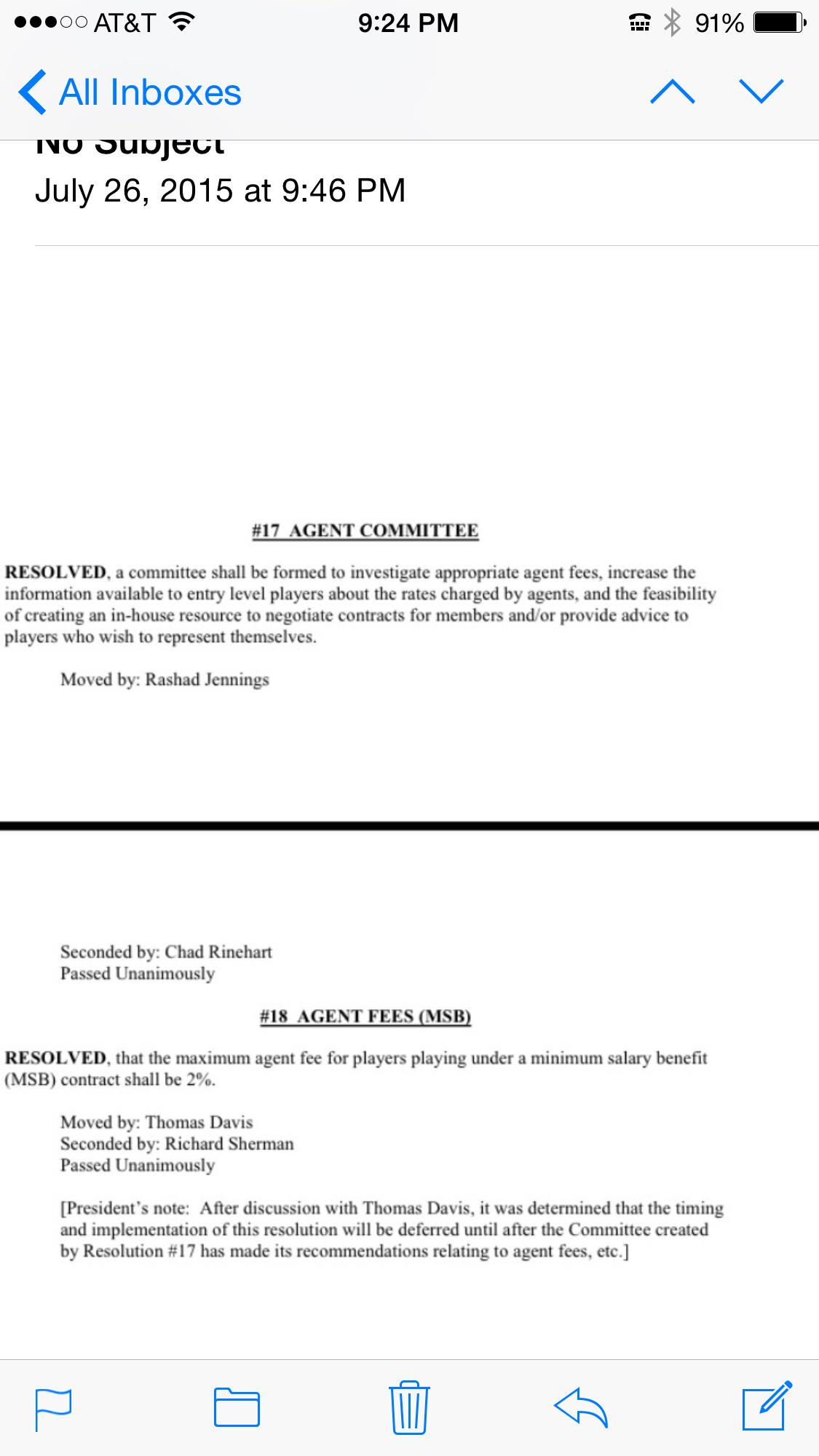
  • If more people really understood what was in store for them once they became full-time contract advisors, maybe fewer really would get certified. I mean, check this out. It’s a copy of the minutes from the last players association meeting, and it shows that the players are actually considering dropping the standard commission on contracts from three to two percent. If this happens, it will be nearly impossible for new agents to recover their expenses.
  • The NFLPA is a very good thing for players in some ways. It has been a leader in demanding certification for agents, and ensuring that they actually know what they’re doing with regards to the Collective Bargaining Agreement. This is very important. On the other hand, the union regularly runs over the agents who are supposed to be advocating for the players. To wit: the NFLPA is assisting a top NFL player who’s trying to negotiate his own deal, and it very rarely intervenes when an agent tries to poach another agent’s clients.
  • When there’s no justice and no reason to have a presumption of fair play, it’s pretty demoralizing. The upside for the union is that so few people know how this business really works. So many young, idealistic people get into this game thinking the players are the victims; it’s a narrative that’s advanced by the media and people around the game. What you find out quickly, however, is that most of the people on the ground floor of the business — the less-established agents, trainers and financial planners who are trying to earn a foothold in football — are actually pretty earnest and fair-minded. Not all of them, mind you, but most of the ones I’ve met.

This is one reason why I’m pretty enthusiastic about ‘The Agent,’ which kicks off in about a week and a half (Tuesday, Aug. 11, on the Esquire Network). It’s a chance to see contract advisors conducting business in jeans and collared shirts rather than three-piece suits or leather jackets. It’s a chance to see them operating alone and uncertain, instead of talking fast and with total confidence.

I hope, for better or worse, it’s a great learning tool for anyone interested in the business side of the game. I think it will be.

WSW: Why Character Matters

Tags

,

The last seven days have been very eventful for a now-former Saints player, Junior Galette. The DE/OLB was released by New Orleans two days ago in the wake of a series of events (some reported, some not so much) that were too much to bear for head coach Sean Payton.

It’s easy to look at the Saints as victims here. After all, they had signed Galette to a hefty contract about a year ago on the heels of a big 2014 season (his ‘arrival’ was even saluted with a locker full of basketballs, courtesy of his teammates). They believed in him. They gave him his shot as an undrafted free agent, patiently coached him up and watched him flourish, then rewarded him.

The truth is that they took a calculated risk, and it’s one of the reasons they self-destructed last season. The Saints moved a lot of very talented players since last season, and the only explanation could be that they made the locker room a dysfunctional place. Galette has to have been part of that problem, but it’s not like Payton and Co. shouldn’t have expected this. His domestic violence incident just added fuel to the fire.

Galette got run out of Temple for a number of reasons, but there were whispers that one of them was that he punched a fan on the way off the field. Of course, everyone makes mistakes, but the point is that Galette didn’t seem to learn from them.

Leading up to the 2010 NFL draft, I heard stories about his behavior. Mind you, the one time you have to stay clean and sober-minded is during the 4-5 months before the draft, when every eye is on you. He couldn’t pull it off. I’m told he required daily 24-hour supervision during his pre-combine training, almost as if he were a toddler. In fact, one day when he was left unsupervised that winter, the hotel staff had to call his advisors, alarmed because he had disappeared, leaving his room strewn with drug paraphernalia.

Before his release, the Saints were a team with an unhealthy cap situation. Because they had to cut Galette so early in his deal, the team is in serious peril. Here’s how J.I. Halsell of NFLContractMetrics.com described what the team faces.

“When the Saints extended Galette’s contract in 2014, they guaranteed the 2015 12.5M roster bonus, meaning there was no way for them to get out of the 12.5M obligation. The only thing they could do to soften the cap blow was to convert it to a signing bonus in March of this year (which they did). From a cash payment standpoint, their hands were tied. The takeaway is that things obviously drastically changed from September 2014 to now. In Sept 2014, they felt comfortable committing to Galette through at least the 2015 season, but as we head towards the 2015 season, he’s now no longer a part of the team.”

At our 2015 ITL Seminar at the combine, former Bears GM Phil Emery said that every scout who wants to disallow a potential draft pick must ask himself the question, would you rather play with him or against him? That may be true, but there’s a major risk associated with adding players that have so thoroughly shown that they are a character risk.


NFLPA Exam Reaction

Tags

I spent most of Friday afternoon and Saturday gathering feedback from several ITL clients who took the NFLPA certification exam last week in Washington, D.C. Here are several of the reactions I got to the test, provided with minimal editing:

  • I thought I did great. I just could see the tricks in the questions . . . and understood how to answer.
  • The test questions . . . were totally different and brutal. Some of the wording on the questions on the test was ridiculous.  In fact question 60 about a player leaving the squad, I don’t believe the answer was even one of the 4 on the test.
  • No clue how it went. Had to rush on 3 to 5. And was stumped on a couple. Probably gave up a few easy ones due to time. But I’m talking with (a fellow test-taker), and seems like I did well on the tricky language ones. First hour was really good. Hour 2 was where I fell behind, but mostly the hour-and-a-half to 2 hour slot is where I fell (behind) a little. Then hour 3 was pretty good on being able to get to the end and answer the rest. Ones where I screwed up is where I left a few blank, then guessed, then a couple where I left it at one or the other. I feel like I really screwed up on giving some questions away. There really only was a few where I wasn’t sure. The rest that I missed was just time.  I guess no one was walking out of there confident. Eight weeks is just too long. One minute I do feel fine, ‘cause I remember it can be around 18 questions you can get wrong, and I felt good about the ones I actually spent the time to answer. Thanks though, definitely helped to have guidance from (the ITL practice exam).
  • It was really hard but I think I did fine. It was difficult, not gonna lie. But I was prepared.
  • It was tough. I think I passed but wish I was more confident. . . I didn’t study much. Hope that doesn’t come back to bite me in the ass. . . also some questions were poorly worded, in my opinion. Two of them in particular that I can argue back and forth between two answers. I’m sure I did fine, given the (70-75 percent) pass rate.
  • Thought it wasn’t bad. Didn’t know a few questions though, probably 4-5.
  • I think it went well. Then again, it’s hard to know. The exam was long so not much time to waste on questions. Since it’s a scaled passing grade, hard to know how it went. Happy it’s over, though. The (ITL practice exam) was helpful. I think the best thing would be more questions to practice managing the time. I finished the 60 questions with 20 minutes left in the exam, so I had time to review my answers a bit. Not all, but two-thirds, I would say.
  • It was challenging. You definitely had to pay close attention to the wording to find out exactly what the question was asking, especially since some questions had full sentences that weren’t needed in finding the answer. Would love to know how everyone scored. So many different opinions (on how the test went for everyone). The practice exam was definitely helpful. Saw similar questions on the exam. Not all the exact final questions but the concepts and thought process to the answer was the same. I feel pretty confident overall.
  • Tricky, but I think I did well. Looking around the room, I’d expect (a variety of opinions on the test). Wide range of personalities.
  • I feel OK about it but it wasn’t easy. Finished with 12 minutes left to spare. Hopefully the curve is low.
  • Test was challenging. Thought I did pretty well though. Had answers that made sense on all questions. I either aced it or bombed without knowing. I’d say 80-90 % of people stayed the whole three hours. Heard more than a couple say they ran out of time and had to guess on the last 5-10 questions. It was about what I expected. They still gave clear indication on some questions that would be asked in the lectures. But not all.
  • It was (hard), but (the ITL) practice test helped a lot. I’d say a solid 10 of your questions in different fact patterns were on there.
  • Extremely (hard). Lots of questions on what advisors would do in certain situations. I was blown away.
  • Harder than the practice test for sure, but I (felt) pretty good walking out. . . . Hopefully the results come back like that but I feel like they went over just about everything so as long as you were diligent in the seminar almost everything was covered. There might have been three that they didn’t cover to see if you could find it yourself, but no more than that.
  • The exam went well. Some tricky questions but I felt prepared because of the (ITL practice) exam questions. It was tricky, but there were parts where I just breezed.
  • Test was challenging but fair. Your practice test is very helpful and puts one in the right state of mind.
  • Test was way harder than I anticipated. They did a terrible job of going over benefits this morning – had a really young guy who went really fast. There was a workman’s comp question that really stumped me. They went so fast this morning that we were able to start the test an hour and a half earlier than planned.
  • Bro, I killed that test. Thanks for everything, man.
  • It was pretty easy (I say that knowing I could fail). Was done with about 45 minutes (left) and spent the next 30 rechecking answers. Either way, thanks for all the help.

Three Points on ‘The Agent’

Tags

I just watched the first edition of ‘The Agent,’ which follows four NFLPA contract advisors through the run-up to the 2015 NFL draft. It kicks off Aug. 11 on the Esquire Network at 10 p.m. ET/9 p.m. CT. Here are three thoughts.

  • Think of every show that’s ever purported to show the life of a sports agent. Let’s see. You’ve got ‘Jerry Maguire,’ of course, and ‘Arliss.’ You’ve got ‘Entourage,’ and now ‘Ballers’ (boy, HBO sure loves agent stuff). You’ve got Morgan Spurlock’s documentary, ‘The Dotted Line.’ You’ve got ‘Super Agent,’ which aired in 2005. I’ve never seen ‘Ballers,’ and I’ve only seen bits and pieces of ‘Maguire’ (which really surprises some people). I’ve seen several episodes of ‘Arliss,’ though it was more of a screwball portrayal and not really to be taken seriously. I saw one episode of ‘Super Agent’ and nearly vomited. I’ve seen one episode, I think, of ‘Entourage.’ I saw Spurlock’s documentary several times. Anyway, ‘The Agent’ puts them all to shame (though I don’t grade ‘The Dotted Line,’ which was very good, alongside the rest of them). If you read this blog, you are not gonna want to miss it. In fact, set the DVR right now. I’ll wait.
  • I’m proud to say the three people I’m closest to the in the show all come off as real people. No putting on airs or strutting around in sunglasses that cover their entire face. Two of the agents featured spend their first minutes on air riding in limos, putting on designer suits and the like. Bright lights, big city stuff. But two others, Ed Wasielewski of EMG Sports and Peter Schaffer of Authentic Athletix, are just regular guys, dressed in regular clothes. If you sat next to them on a plane, you’d never know they were agents. Meanwhile, Rick Roberts, who handles personnel for Pro Source Sports, is every bit the man on the show that he is in real life: knowledgeable, approachable, likeable and down to earth. All three of my friends are as authentic on the screen as they are in real life. You’ll enjoy getting to know them.
  • I know I come across as a party pooper when I’m always preaching how much work agents do, but it’s true. You get to see it in this show. I’m sure there will be plenty of private planes and invitation-only parties in later broadcasts, but the first edition featured a lot of nights spent alone in hotel rooms and long, lonely car rides. There’s one scene that captures the life of an agent perfectly. An agent has been courting a player for months when, out of nowhere, he’s asked to meet the player’s ‘mentor.’ The mentor wants to meet the agent in the next 24 hours, which means a cross-country flight on a ticket bought a few hours before wheels-up. The agent sits in the darkness of his car, alone and exhausted, as he ponders whether or not it’s worth the energy and expense to drop everything and meet with this person he doesn’t know, hoping it gives him an edge. That, right there, is the essence of this business.

We’re about a month from the second episode, and I can’t wait. If you are interested in the football business and really want to see it, warts and all, you’re going to want to watch every episode. Check it out.

WSW: Getting Creative

Tags

,

I don’t talk about it much, but I think one of the themes of this blog is that to be successful in this business, you must be ‘your own man.’ You must be creative. You must be willing to go your own way.

J.I. Halsell of NFL Contract Metrics had an instance during his time with the Washington Redskins that his ability to think a little differently was a key asset.

The team had just drafted LSU SS LaRon Landry as the sixth pick in 2007. Landry would give the ‘Skins a pair of aces at the safety position as he teamed with FS Sean Taylor, the team’s athletic superstar at the back of the secondary. The problem was that though Landry, like Taylor, was an athletic freak (4.35 40 at the combine), the position where he’d be playing would not lend itself to easy incentives. Box safeties don’t rack up sacks and interceptions; they’re more like linebackers whose value is in stopping the run and intimidating at the line of scrimmage. That meant J.I. would have to come up with other ways to compensate him without the usual incentives.

“(Landry was) not a ball-hawking free safety like most first-round safeties,” J.I. said. “He was a box safety that went in top 10. Back then, there was a lot more leeway about how (a contract) was structured. There were not many box safeties in the top 10. How do you create an incentive package for a guy that wouldn’t get a lot of turnovers and interceptions? How do you judge his productivity, while also mitigating the team’s downside so that the team didn’t have a lot of risk?”

He said the ability to think outside the box (no pun intended) is key whatever side of the table you’re on.

“Once you get to a team, or to an agency, you have to think creatively so you’re compensating the player or the team accordingly. LaRon was just as much a freak (as Taylor) in terms of his testing at the combine. He didn’t have the length, but he could run. We had two freak athletes at safety, and how do we compensate these guys?”

J.I. was able to craft a deal that had the right mix of base salary and incentives that were enticing to Landry and his agency, New York City-based Lagardere Unlimited, and the team was able to get him to camp on time, signing him shortly before camp started in late July.

I think this is important if you want to work in this business because there’s no real formula for success. You can try to storm the gates of NFL teams in an attempt to be a scout, or you can save your pennies and take a shot at being an agent, but if you’re creative, you might be able to find your own way to the football heights.