• About

Succeed in Football

~ The daily blog written by ITL's Neil Stratton

Succeed in Football

Tag Archives: NFL Scouting

WSW: When, Why and Where Do Teams Gamble in the Draft?

07 Wednesday Oct 2015

Posted by itlneil in ITL, Scouts

≈ Leave a comment

Tags

Gambling, NFL Scouting

Some years ago, I had a conversation with former 49ers scout Oscar Lofton that we filmed for ITL. It was pretty wide-ranging, and I had the time of my life as we discussed a number of topics related to scouting. Here’s an interesting story about Deion Sanders that Oscar shared that day.

One thing we talked about was a team’s philosophy toward the last rounds of the draft. My contention was that teams see them as throwaway picks, and I know the 49ers did specifically because, in 1996, they drafted identical twins Sean and Sam Manuel out of tiny New Mexico State as a sort of lighthearted public relations move.

Here are some excerpts from our conversation with my analysis and conclusions after each passage.

Lofton: “From late-fifth round all the way through the seventh, sometimes you have — because of a trade . . . or because of some kind of deal that’s happened, or some compensatory trades that have been made, or people that left your club — you get some of those picks, and you try to kind of stack up with some sixth-, seventh-round people.”

Analysis: I think this is interesting because even though Oscar left the Niners in the early ’00s, he’s admitting that even then, the team looked at any picks after the late fifth round as strictly a gamble, and therefore they rolled the dice on players that were boom-or-bust types. My observation is that teams are doubling down on this now, taking guys that fit all the metrics but that might not have the Football IQ they need. I think a great example of this is the Saints, a team that hit big on some boom-or-bust types (TE Jimmy Graham) as well as late-rounders (WO Marques Colston) and undrafted free agents (DE Junior Galette), then got lulled into a pattern of gambling earlier in the draft, which came home to roost in 2014 with several picks (second-rounder Stanley Jean-Baptiste and fourth-rounder Khairi Fortt) that, one year later, are no longer on the team.

Lofton: “Generally like from the fifth round on, sometimes . . . you take some phenom, you know, some guy that can jump out of the gym and everything, but he’s a football player, not just somebody that can run fast, but can catch, or can cover, or whatever you need him to do, but some kind of athlete sticks out at that level. What does he bring that makes us a better team? Well, he brings speed as a receiver, or he brings deep coverage ability as a defensive back, or he brings the ability to pass rush off of stunts, you know, as a secondary member or something, or a great special teams presence, or . . . the ability to return a punt, or to run after catch.”

Analysis: Maybe this is the key. Though scouts I talk to agree that good teams take the best athlete available early in the draft, maybe the best strategy late in the draft is to draft for need. Take an athletic ex-basketball player if you have a need at tight end or defensive end, or an ex-wrestler if you need a good interior lineman, or a track guy if your secondary is too slow.

Lofton: “You say, ‘those aren’t that important to the team,’ but you look at how many of the seventh-round people and the free agent people that have made (the Niners), and made us better, and they become crucial to you. Usually the ones that flop big are the first rounds, the . . . early picks, you know? Because you put so much into them, and then because you’ve got so much into them, you have to hang with them for so long. So while you’re hanging with them you’ve got to have somebody playing. So some of those seventh-round picks and free agents are doing the playing, and they’re getting all the money until you can figure out a way to unload (the struggling first-rounders), or until they develop.”

Analysis: Oscar’s take here is what makes me scratch my head. It seems counter-intuitive to gamble with the last three picks of the draft when there are so many players out there that excel despite being late picks or not drafted at all. More and more, teams are taking players who come from the lower levels of college football, or who played other sports primarily or otherwise excelled in workouts despite meager on-field credentials. There’s a fine line between taking a player with upside and taking a player who’s got as much chance of winning the lottery as he does of making the team.
Why Do Rookies Bust?

17 Thursday Sep 2015

Posted by itlneil in Scouts

≈ Leave a comment

Tags

NFL Scouting

It’s a simple question: what makes a can’t-miss player fail?

I asked five scouts the same question, and I got a variety of responses. I expected them all to be a variation of ‘you can’t measure heart, and you have to really want it, and some players don’t,’ but it turned out to be much more than that.

Here are few responses that I got back in texts:

  • “GM and Coach-driven draft pick:” I think this response was intended to illustrate that sometimes GMs want a player, but a coach doesn’t, and either the player proves to be a bad fit for the team, or the coach doesn’t give the player a sufficient chance to succeed. I’ll buy that. It’s one reason.
  • “Reaching for a player because of need. You pass on a great player because you think you are good at that position, (and take) a player not worthy of that slot. You are one injury away from not having a great player at that position:” I think this makes sense, too. Florida State’s E.J. Manuel comes to mind. Despite a great series of pre-draft workouts, most scouts I know saw him in the third or fourth round. The Bills, however, badly needed a passer, and three years later, he’s barely hanging onto a roster spot. “It’s not the player’s fault he was overdrafted,” my friend added.
  • “There’s not a single reason. Each player — hits and misses — is unique:” I expected to get this answer from several sources, but most scouts were more specific.
  • “The No. 1 thing is they can’t play at the mental speed of the pro game. The complexity of the pro game . . . they’re not able to handle the mental pressure that is applied by having to play so much faster. It’s so much more complicated. You have to watch tape. If guys are slow reactors on the field .. . if QBs hold the ball too long, and don’t see progressions, and don’t let the ball go, they’re never gonna do it in pro ball. If a lineman can’t see the blitz, and doesn’t pass off well on stunts, there’s no way he’ll do it in pro football. You get all these wonderful measurables added up, and a coach will say, “we can fix it.” Most of the time you can’t. It’s between the ears. It’s so much mental. If you can’t play strong and sharp and fast, you start to lose confidence, and then you can’t function:” I would agree with this, but it’s a little hard to measure. How do you predict who will be able to process the speed of the game, and who won’t? It’s not the kind of thing the Wonderlic can measure.

I think draft success is a function of talent and ability, mixed with system and ability for a team to adapt to a player’s talents (and vice versa), and finally, where a player is drafted. First-rounders get paid reasonably well, and for a lot of players, a switch flips and the hunger isn’t the same as it is for a fourth-rounder who thought he was going at the top of the second round.

There are probably many more theories on why players don’t make it. I hope to revisit this topic again in the near future.

WSW: Up On The Table

16 Wednesday Sep 2015

Posted by itlneil in Scouts

≈ Leave a comment

Tags

NFL Scouting, Senior Bowl

The first time I ever heard the term “getting up on the table” in the draft room was one of my first years at the Senior Bowl. It was at a practice, and someone was congratulating Seahawks scout Derrick Jensen for a pick the team had made in the later rounds.

It was a defensive lineman, as I recall, though the exact player I can’t remember. “Yeah, I really had to get up on the table for him,” Jensen said.

Since then, I’ve heard the term dozens of times, but rarely have I heard exact stories of a scout aggressively lobbying for a player.

I dug this one up from former Bears GM Phil Emery. He told it at the 2015 ITL Seminar, the annual event we hold at the combine for our clients, after meeting former Dolphins wide receiver Chris Chambers at our event. Chris was there representing his combine prep facility, The Chamber, which is based in South Florida. If you’d rather listen to Phil tell it himself, click here. It starts at the 3:00 mark and runs until 4:37.

“It was 2001, OK? I was the positional cross-check guy for wide-outs for the Chicago Bears. It was my first go-round with the Bears during that time, and I’ll tell you a little story.

“(Chambers) will always be in my memory bank because I was pushing for (him) hard, right? I love those big hands, and that catch radius, and all that end zone work. (He) had a catch where (he) went up over the top in a corner of an end zone and grabbed a one-hander, and it was so beautiful. It was such a moment of grace and athleticism, and just beautiful to see. The reason I’m in (football), OK, is because I see this as art. This brings joy to my heart to watch somebody do something that no other human being can do. It’s special. It’s special, and that catch was special.

“So we’re having a little debate about (Chambers), OK? And so as the positional cross-check scout, I had wide-outs, so I stack all the wide-outs in the country from one down, OK? Well we were responsible at that time — this was way before digital, OK? This is VHS and 16 MM tape. We were responsible for making the profile (tape) and cut. So what I did is, I stuck it on that catch, and repeated (his) catch 10 consecutive times so that everybody got the feel about how I felt about (him), so Mark Hatley, our Vice President of Player Personnel at that time said, ‘hey, Phil, that’s enough.”

I think it’s an even more interesting story when you realize Phil was right about Chambers. The Bears took Michigan’s David Terrell that year with the eighth pick in the draft, and Terrell was an unmitigated bust. In addition to Terrell, wide receivers taken in the first round that year included Koren Robinson (the ninth pick, to Seattle), Rod Gardner (15, Redskins), Santana Moss (16, Jets), Freddie Mitchell (25, Eagles) and Reggie Wayne (30, Colts).

Taking it one step further, receivers taken in the second round before Chambers were Quincy Morgan (33, Browns), Chad Johnson (36, Bengals) and Robert Ferguson (41, Packers). I think you could argue persuasively that only two receivers in this group, Wayne and Johnson, had better careers than Chambers. I guess Phil was right.

A Scout On How To Be A Scout

14 Monday Sep 2015

Posted by itlneil in Scouts

≈ Leave a comment

Tags

NFL Scouting

I was on the phone with a longtime friend who’s an area scout last week. I was discussing with him some of my interns, and how often they are hoping to get into the business some day. I think I mentioned that I’m always trying to ‘crack the code’ for finding opportunities for young people in such a situation. His response was that it’s very simple.

“I would tell them to get G.A. jobs,” he said. “That seems to be where everyone is hiring from these days.”

Could it be that simple? Well, maybe so.

At ITL, we track these things, and do brief backgrounds on the scouts that are getting hired by NFL teams these days. I think most scouts that have been in the game more than 10 years were former coaches who moved in through their relationships. Relationships are still very important, which is just another reason to find a grad assistant job if you’re in college and hoping to be an NFL talent evaluator someday. That’s especially true if you’re a grad assistant assigned to the personnel department, a relatively new part of college staffs.

Think about it.

  • You get to work around football, obviously, even though college ‘personnel’ jobs vary widely in what they actually mean.
  • You meet key people around the game. This is especially true if you are able to help out with pro days, or even organize them; most college coaches see this as a chore, not an opportunity.
  • You get to learn all the buzzwords, practices, habits and expectations of people around the game.
  • Most importantly, you will probably meet several actual NFL scouts, and perhaps even win them over. There are no better people for bringing you into the league than those already in the league.

At the end of the day, an all-consuming work ethic is the most important thing you need to get into the business, but connections are an important part, too. If you’re a college student reading this right now, I urge you to do whatever you can to volunteer for your school’s team. Do it right now. Even if you’re already a sport management major. Even if you’ve never picked up a football in your life. It’s probably the best way to get you on track, immediately, for a job in football.


WSW: Who Does The Best Job of Drafting?

09 Wednesday Sep 2015

Posted by itlneil in Scouts

≈ Leave a comment

Tags

NFL Scouting

One thing that intrigues me (and a lot of people) is the scouting process, and how NFL teams evaluate players. Is there one team that seems to do a better job than others, and that most NFL teams recognize as superior in the draft process?

In Fall 2014, during a presentation for sport management majors at Rice University, I asked former Texans, Redskins and Lions scout Miller McCalmon if there was one team known around the league as the best at finding college talent. If you’d rather watch him respond than read his response, click here.

“Without question, the Green Bay Packers probably do as good a job as anybody in the league. Somebody did a statistical analysis, and they listed the amount of players, I think at the start of the year (in 2014) that were drafted players. Green Bay had the most percentage of drafted players of any other team in the league. I would think Baltimore would be up there pretty high, too; they do a good job of drafting.

“It was interesting. Along with my duties as a pro scout in Detroit, I did the advanced scouting, so I never watched us play. I was always at our next opponent’s game. I had to write a report, and I’d get that prepared during the week, then after the game I would finish it up and send it to the intern, and he would run it off and hand it to the coaches so they’d have my report from the game. But we would have a section in there of the free agent signings and that sort of thing. A couple of years, Green Bay didn’t have any. Most teams would have four or five guys that they signed as free agents; well, Green Bay wouldn’t have any at times. Now, later on in the season, it would be more because they’d have to pick up somebody because of injuries or that sort of thing. But I think statistically, if you go down and you look at their roster, they have more drafted players on their roster than probably any other team, and I’d be surprised if there was anybody that didn’t have that.”

Three Things to Watch for in The Agent: Ep 5

08 Tuesday Sep 2015

Posted by itlneil in Scouts

≈ Leave a comment

Tags

NFL Scouting

If you’re an aspiring football professional, tonight’s a great place for insights into the business side of the game. Here are three things to watch for in Episode 5 of The Agent (10E/9C, Esquire Network):

  • The show opens in St. Petersburg, Fla., where the Shrine Game is played. You’ll notice that the field where practices are held is ringed by scouts, coaches, agents, financial planners and others who work in the game. What you probably can’t tell is that the group is very loosely regulated. Almost anyone can walk in there, and as long as they don’t make a spectacle of themselves, have pretty much unfettered access to hundreds of potential NFL employers. I’ve always wondered why more eager young job-seekers don’t take advantage of these games. Not a year goes by that I don’t see dozens of young people hoping to work in football at the combine, because it gets all the press, but rarely at all-star games. Access is way better at all-star games than it is at the combine, which is like a party for invitees only. If you want to win a job in football, you’re going to have to irritate a whole lot of people before you get that one champion who’s willing to take a risk on you. There’s no better place to ‘irritate’ lots of people in one setting than at these games.
  • Speaking of jobs, there are three elite training facilities portrayed in tonight’s episode. They are the Pensacola, Fla., location of Exos; Miami-based Bommarito Performance Systems; and Weston, Fla.-based Fit Speed. All are excellent, and all are pretty work-intensive. I’m always hearing from young people who want to find a profession in football, and the default job is always scout or agent. Why not consider the combine prep business? It requires lots of people and has several facets to it, and is still taking shape, with lots of permutations and new applications. A young person who volunteered with a top combine prep facility could very quickly learn the business, identify trends, and quickly make himself very useful/valuable to key people. In fact, I bet one could make the contacts to do almost anything in the business from a combine prep service. Lots of paths cross in the training field, and there are dozens of good training programs that work with players all over the country.
  • One more thing to notice: this week’s show takes place in the January/February time frame, two key months in the draft process. Almost the whole show is shot at an all-star game and training facilities, all in Florida. If you are looking for NFL opportunities, you have to go where the football business is, and the Sunshine State is essential to the draft process, for various reasons. If you’re already in the state, you’re in great position to succeed. If you’re not, but you have easy access to the state, take advantage of that. Florida is not only one of the top 2-3 states for football talent, but it’s also got a warm-weather climate that really helps in the months leading up to the draft.

Enjoy the show, and don’t forget to join in during our live-tweet tonight. I’ve got four pages of notes to churn out tonight during the broadcast. Don’t miss it!

WSW: Five Facts About Larry Donnell

03 Thursday Sep 2015

Posted by itlneil in Agents, Scouts

≈ Leave a comment

Tags

Larry Donnell, NFL agent, NFL Scouting

One of the best things about sports in general (and football, especially) is that it’s full of good stories. Today, let’s talk about Giants TE Larry Donnell, a player was almost completely unknown until he burst onto the scene with three TD catches in New York’s win over the Redskins last year in a Thursday night game.

The full story of Donnell’s ascension from lightly used tight end at Grambling to one of Eli Manning’s favorite targets is beyond the scope of today’s post, and the New York Post has already done a good job with that here.

I just want to point out a few of the interesting aspects of his story that didn’t make it into the Post’s story.

  • He was fired by his first agent: His current agent, Tamika Cheatham of 413 Sports in Glendale, Ariz., only signed him after Donnell’s trainer called her, begging her to take him, in the Spring of 2011. She only knew the trainer because she had worked with him before on another long shot player. “The interesting thing is that after the Redskins game, that agent was trying his darnedest to get him back,” Tamika said.
  • He tried out for the Arena League, CFL and even the defunct UFL: “I didn’t even meet him until after he went to the NFL Super Regional, and I brought him out here to do a workout for the (AFL’s Arizona) Rattlers and that’s when I met him, and the Rattlers thought he was too green.”
  • The Giants originally contacted him via email: Due to the lockout, NFL teams didn’t sign undrafted free agents in 2011. That meant they couldn’t reach out to him until July when the lockout ended. By then, Donnell had changed phone numbers from when he was workout out for teams in March, but someone in the Giants’ front office found an email address that still worked.
  • Despite his inspiring story, he’s not a budding Michael Strahan: “When he first had that game, for the first week or so, he was on every news and radio show, and he is definitely ‘afraid’ of everything outside the locker room. I’ve offered to get him media training, but Larry was like, ‘no, I just can’t do it yet.’ He’s really, really low key.”
  • Tamika helped him keep focused during his two-year pre-Giants odyssey: “I met another young man (a previous client) who had a chance with Tampa Bay, and that fell apart because he didn’t have the work ethic, so I rode Larry pretty hard.”


10 Questions That Might Indicate You Won’t Be Drafted

31 Monday Aug 2015

Posted by itlneil in Scouts

≈ Leave a comment

Tags

NFL Scouting

A week ago, I discussed 10 questions that an aspiring NFL player might ask himself that could give him a better idea of if he’d be drafted by the NFL. It was pretty well-received, so this week, I thought I’d look at the other side of the coin.

As always, the disclaimer — you can’t determine whether or not a player will be drafted or not drafted on paper. This is just a guide, a series of questions that might be indicators. Nothing more.

Here  goes.

  • Did your school hold a ‘junior day?’
  • Did you play below the FBS level?
  • Were you a regular starter for your team less than one full season?
  • Do you play offensive guard, center, inside linebacker, fullback, punter or kicker?
  • Did you change positions immediately before your senior year?
  • Have you ever been arrested for any offenses related to sexual or domestic assault?
  • Are you more than 20 percent below the average NFL height, weight or speed for your position?
  • Did you suffer a season-ending injury as a senior?
  • Did you experience more than one surgery to any one organ/joint/muscular group during your college career?
  • Did you play for a college west of the Mississippi?

The first two questions are related. Most FBS schools do hold junior days, whereas most small schools do not. What’s a junior day? Briefly, it’s the day in the spring (usually March or April) that the two big scouting combines come through and collect height, weight and 40 time for as many rising seniors as possible. Also, no more than 15-20 players from non-FBS schools get drafted each year, and usually late. That’s less than 10 percent.

Question 3 is pretty common sense. Question 4 is also pretty straightforward — these are the non-sexy positions most teams see as a commodity.

Question 5 is a bit of a feast-or-famine question. Many teams actually find good athletes at new positions as very enticing, so it’s possible this could be a benefit. But more often, it’s a negative.

Question 6 is a little tricky. Players get arrested all the time, but all such offenses are not created equal. Any kind of sexual offense is a big no-no, and obviously, we’re in an era where teams are not at all forgiving when it comes to domestic assaults. It’s important to note, however, that if a player is supremely talented, some team will roll the dice.

Question 7 is a basic are-you-right-physically-for-the-league question.

Question 8 is not hard and fast, but usually, teams want to be absolutely sure a player is healthy when he comes to camp so they can properly evaluate him. If not, he’s damaged goods and no-go. Question 9 is also health-related, and usually this area is cleared up during ‘medical day’ at the combine.

Question 10 is an illustration of the fact that all teams do not visit all schools equally. Remote schools, especially smaller and less successful ones, don’t get the same exposure.

As always, these are not in any way the final measure for players hoping to make it to the league. Still, I feel it’s a pretty good overview of the negatives that are foremost in the minds of most scouts.

WSW: A Peek Inside Pre-Combine Interview Training

26 Wednesday Aug 2015

Posted by itlneil in Agents, Scouts

≈ Leave a comment

Tags

NFL agent, NFL Scouting

 Peter Schaffer w-clients in Fla

Today, for WSW, I thought I’d tell the back story associated with something you’ll see next Tuesday on ‘The Agent,’ and that you saw a glimpse of in the tease at the end of the show.

Next week, Episode 4 showcases Peter Schaffer of Authentic Athletix as he brings in former Dolphins scout Mike Murphy to put three prospects through interview training. He sits down with Florida State DE Mario Edwards Jr. (2/35, Raiders), Louisville SS Gerod Holliman (7/239, Steelers) and Syracuse OB Dyshawn Davis (UDFA, Steelers), asking them the tough questions they’re likely to hear from scouts. Questions about disciplinary situations and arrests, drug use, injuries and other ‘negatives’ that might be part of each of their background.

This is a common practice; more and more, ex-scouts are hired by agents to help their clients become more comfortable during the scouting process. At ITL, we help connect agents to former scouts all the time.

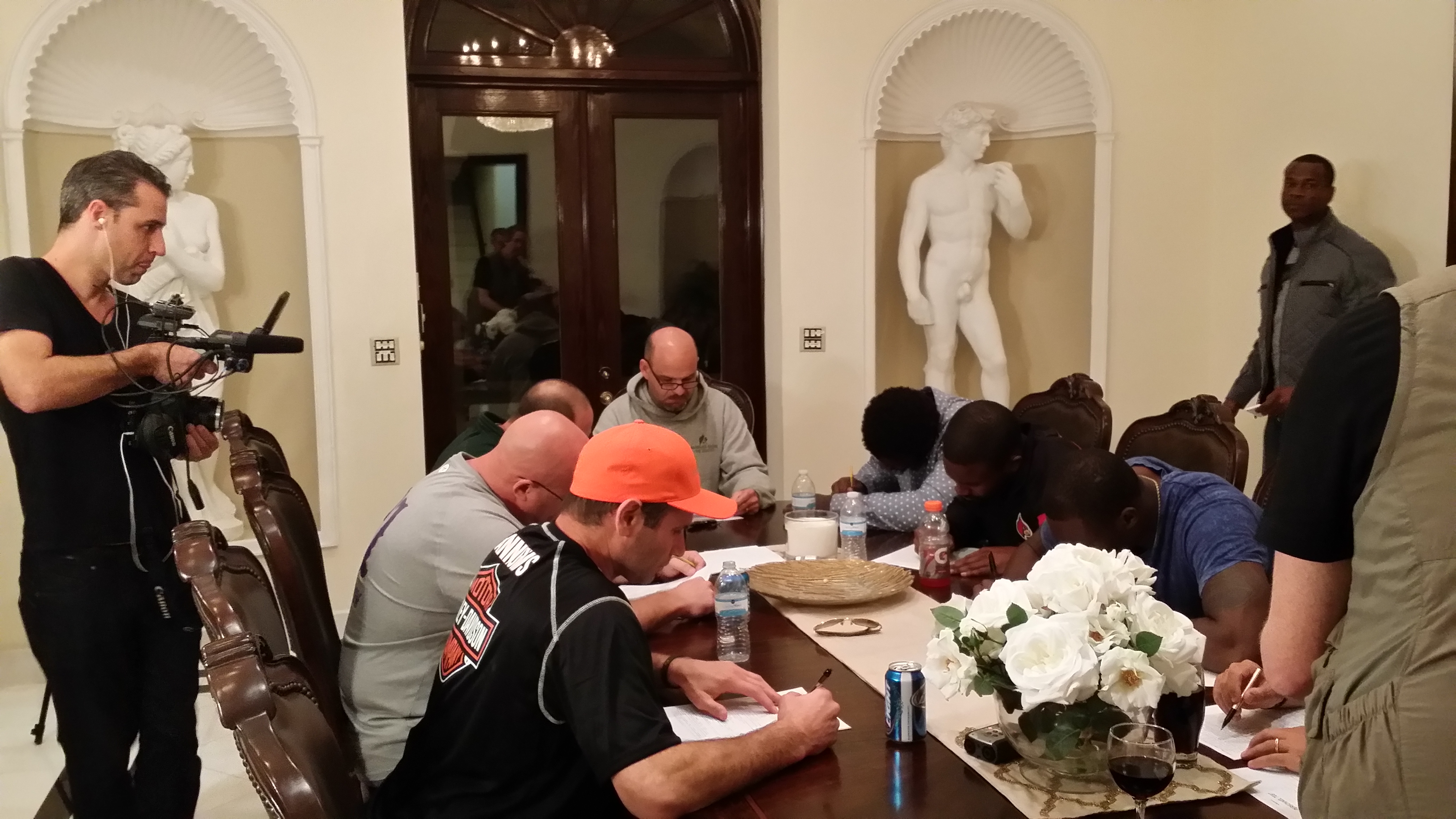
At any rate, you’ll see a lot more than just three players sitting at the table with Mike. You’ll actually see quite a few older gentlemen sitting there (as you see in the picture above), and there’s a reason for that.

At 53, Peter remains a competitive lacrosse player, and annually plays in a major national tournament for players 40 and over. The tournament, held in Florida over Martin Luther King weekend, falls on the days when the Shrine Game is played (Saturday) and the Sunday before players arrive in Mobile, Ala., for the Shrine Game. It’s a brief break during a busy time.

Every year, for the tournament, Peter rents a house in Ft. Lauderdale, where several of the lacrosse players bunk for the weekend, as well as his draft clients. Many of his lacrosse teammates are graduates of Ivy League and other esteemed schools (Cornell, Franklin & Marshall, Brown and other schools). Another teammate, Anthony Katagas, is now a major Hollywood producer (he won an Academy Award for ’12 Years a Slave’).

Last year, to create an interesting scenario for ‘The Agent,’ Peter decided to conduct an experiment. He pits his lacrosse buddies, most of them doctors, lawyers and captains of industry, against his players as they take the Wunderlich, the basic intelligence test for the football industry. It’s almost like a 12-minute SAT exam.

Peter hinted that he created distractions during the test, aside from the cameras chronicling every move at the table. He also said his teammates’ scores, as compared to those of his clients, were pretty comparable.

It will be interesting to see what develops. We’ll have to wait until Tuesday to find out. I hope you’ll check it out.

10 Questions for NFL Prospects

24 Monday Aug 2015

Posted by itlneil in Scouts

≈ Leave a comment

Tags

NFL Scouting

When I read a piece like this one, it confirms my belief that the league is moving in a baseball direction when it comes to analytics.

More and more, the human element is being taken out of the scouting equation. We’re seeing this as the New England model takes root across the league. In other words, young scouts are hired to measure, weigh and time anyone and everyone who’s draft-eligible, while the directors back at the team headquarters make the real decisions. In other words, low-level employees go get measurables and facts, and evaluation is done by the senior-level minds.

This is probably one reason I’ve toyed for years with putting together a kind of flow chart that college players and their parents could use to give them a reasonable idea of their appeal to NFL scouts.

I’d start with these questions.

  • Would others consider you one of the top 4-5 players on your team?
  • Did you play for a team in a BCS conference?
  • Did your team have a winning overall record the last three seasons?
  • Did you play QB in high school?
  • Did you play basketball in high school?
  • Did you play any other sports in college?
  • Did you start more than one season in college?
  • Do you meet the size/speed minimums for your position (I’d devise a position-by-position grid to reference to answer this question)?
  • Did you play college football east of the Mississippi?
  • Do you play a position other than offensive guard, center, nose tackle, fullback, or inside linebacker?

Question 1 is a basic quality question — the NFL is only for the very best. I’ve seen players that don’t even start on their college teams that expect to play in the NFL. Though it happens very rarely, it’s just not realistic.

Questions 2 and 3 deal more with the competition level a team faced, and how the team fared. Though it’s exciting to talk about small-school sleepers, the facts are that the vast majority of NFL players competed at the FBS level. What’s more, I believe scouts have an unintended bias against losing programs.

Questions 4-6 deal with athleticism. I believe that today, the NFL is looking for explosive athletes first, and football players second. My observation has been that most teams feel they can ‘coach up’ almost anyone, or are at least willing to try.

Questions 7-8 deal with general individual success at the college level. Gauging this is incredibly subjective, but this is at least a start toward measuring ability.

Finally, questions 9-10 measure a player’s ability to be ‘noticed.’ There are simply fewer scouts working what I call the Far West Corridor, which consists mainly of the schools in the West that aren’t on the coast. These are mostly remote areas. Also, players at ‘non-sexy’ positions are often overlooked.

Obviously, you can’t truly determine a player’s NFL chances by simply asking him questions. Too many variables. However, as I try to refine this list, I think it’s at least a good starting point for gauging a player’s NFL chances.


← Older posts
Newer posts →

Archives

Inside the League

Inside the League

Blog at WordPress.com.

Privacy & Cookies: This site uses cookies. By continuing to use this website, you agree to their use.
To find out more, including how to control cookies, see here: Cookie Policy
  • Subscribe Subscribed
    • Succeed in Football
    • Join 89 other subscribers
    • Already have a WordPress.com account? Log in now.
    • Succeed in Football
    • Subscribe Subscribed
    • Sign up
    • Log in
    • Report this content
    • View site in Reader
    • Manage subscriptions
    • Collapse this bar
 

Loading Comments...