10 Questions That Might Indicate You Won’t Be Drafted

Tags

A week ago, I discussed 10 questions that an aspiring NFL player might ask himself that could give him a better idea of if he’d be drafted by the NFL. It was pretty well-received, so this week, I thought I’d look at the other side of the coin.

As always, the disclaimer — you can’t determine whether or not a player will be drafted or not drafted on paper. This is just a guide, a series of questions that might be indicators. Nothing more.

Here  goes.

  • Did your school hold a ‘junior day?’
  • Did you play below the FBS level?
  • Were you a regular starter for your team less than one full season?
  • Do you play offensive guard, center, inside linebacker, fullback, punter or kicker?
  • Did you change positions immediately before your senior year?
  • Have you ever been arrested for any offenses related to sexual or domestic assault?
  • Are you more than 20 percent below the average NFL height, weight or speed for your position?
  • Did you suffer a season-ending injury as a senior?
  • Did you experience more than one surgery to any one organ/joint/muscular group during your college career?
  • Did you play for a college west of the Mississippi?

The first two questions are related. Most FBS schools do hold junior days, whereas most small schools do not. What’s a junior day? Briefly, it’s the day in the spring (usually March or April) that the two big scouting combines come through and collect height, weight and 40 time for as many rising seniors as possible. Also, no more than 15-20 players from non-FBS schools get drafted each year, and usually late. That’s less than 10 percent.

Question 3 is pretty common sense. Question 4 is also pretty straightforward — these are the non-sexy positions most teams see as a commodity.

Question 5 is a bit of a feast-or-famine question. Many teams actually find good athletes at new positions as very enticing, so it’s possible this could be a benefit. But more often, it’s a negative.

Question 6 is a little tricky. Players get arrested all the time, but all such offenses are not created equal. Any kind of sexual offense is a big no-no, and obviously, we’re in an era where teams are not at all forgiving when it comes to domestic assaults. It’s important to note, however, that if a player is supremely talented, some team will roll the dice.

Question 7 is a basic are-you-right-physically-for-the-league question.

Question 8 is not hard and fast, but usually, teams want to be absolutely sure a player is healthy when he comes to camp so they can properly evaluate him. If not, he’s damaged goods and no-go. Question 9 is also health-related, and usually this area is cleared up during ‘medical day’ at the combine.

Question 10 is an illustration of the fact that all teams do not visit all schools equally. Remote schools, especially smaller and less successful ones, don’t get the same exposure.

As always, these are not in any way the final measure for players hoping to make it to the league. Still, I feel it’s a pretty good overview of the negatives that are foremost in the minds of most scouts.
Why So Much Ed on ‘The Agent?’

Tags

Since the Esquire Network series ‘The Agent’ kicked off three-plus weeks ago, I’ve been talking about it quite a bit with other agents, financial planners and other people in the game. Here’s one response I get from them frequently: “Why do they did they film Ed Wasielewski so much?”

That’s a valid question. Ed has not only gotten lots of film time, but he’s also live-tweeted the show and held an AMA (Ask Me Anything) on Reddit on Tuesday. Meanwhile, Jeff Guerriero of Pro Source Sports didn’t even show up on Episode 2, and the real insider-level recruiting video has almost always centered on Ed and his potential clients.

There are a couple reasons for this. No. 1, this show is Ed’s baby. When the show was originally being pitched, it was Ed and seasoned NFL producer Amani Martin doing the pitching. The show was even called, ‘Agent Ed.’ It wasn’t until the Esquire Network expressed an interest that another three agents were screened and added to the show.

No. 2, Ed has put the most blood on the screen, so to speak, of all four agents, and it’s not really close. Here’s something I learned recently. The producers of the show sent high-def, state-of-the-art cameras to each of the four contract advisors to film themselves around the office. Others filmed their kids, or day-to-day business interactions, or other mundane activities. Ed used his to film his final interaction with Connecticut DC Byron Jones as Jones tells him it’s not going to work out, and he’s going with New York City-based SportStars. That’s not the kind of thing most agents want to see on film, but Ed was willing to put himself out there.

The feedback I’ve gotten from most agents has been that they really like Ed, but almost wince when they see him go into a final meeting with a player, knowing it’s not going to turn out well (as with Indiana RB Tevin Coleman and his family). They’re constantly astounded by his willingness to look vulnerable and face rejection on camera. But ultimately, they all praise the show’s authenticity. Each one of them says he’s been in the situations that Ed faces, and that’s why I think the show is a must for anyone who aspires to work in the game.

I’ve also talked to several agents who were approached about doing the show, but didn’t want to take the risks that Ed is taking. It’s still to be determined what impact the show will have on Ed’s practice, and I admire his courage.

If you haven’t given the show a chance yet because you’re busy with ‘Hard Knocks’ or some other show, I encourage you to give it a try. It certainly has captured an audience with people in the game.

WSW: A Peek Inside Pre-Combine Interview Training

Tags

,

 Peter Schaffer w-clients in Fla

Today, for WSW, I thought I’d tell the back story associated with something you’ll see next Tuesday on ‘The Agent,’ and that you saw a glimpse of in the tease at the end of the show.

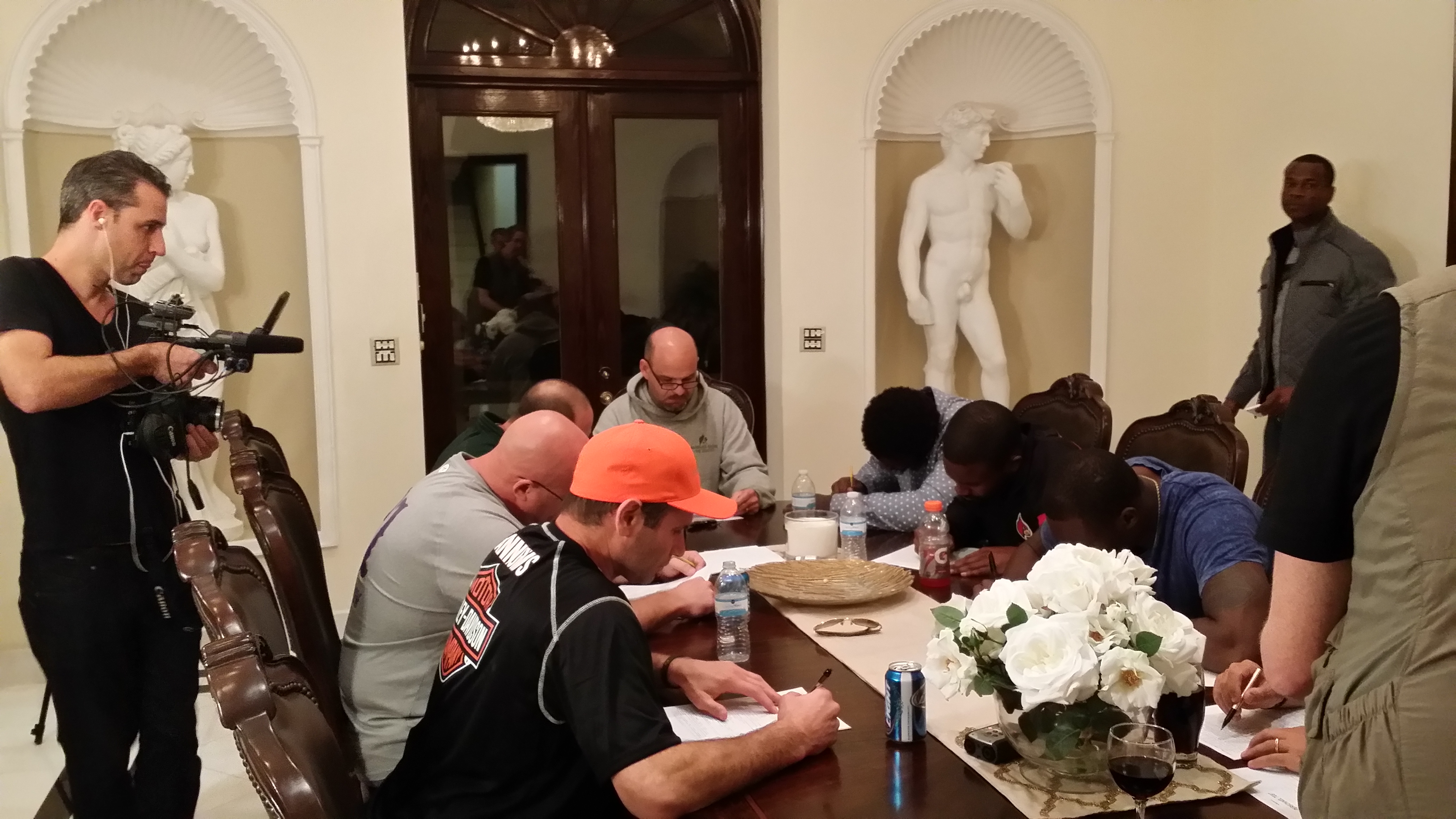
Next week, Episode 4 showcases Peter Schaffer of Authentic Athletix as he brings in former Dolphins scout Mike Murphy to put three prospects through interview training. He sits down with Florida State DE Mario Edwards Jr. (2/35, Raiders), Louisville SS Gerod Holliman (7/239, Steelers) and Syracuse OB Dyshawn Davis (UDFA, Steelers), asking them the tough questions they’re likely to hear from scouts. Questions about disciplinary situations and arrests, drug use, injuries and other ‘negatives’ that might be part of each of their background.

This is a common practice; more and more, ex-scouts are hired by agents to help their clients become more comfortable during the scouting process. At ITL, we help connect agents to former scouts all the time.

At any rate, you’ll see a lot more than just three players sitting at the table with Mike. You’ll actually see quite a few older gentlemen sitting there (as you see in the picture above), and there’s a reason for that.

At 53, Peter remains a competitive lacrosse player, and annually plays in a major national tournament for players 40 and over. The tournament, held in Florida over Martin Luther King weekend, falls on the days when the Shrine Game is played (Saturday) and the Sunday before players arrive in Mobile, Ala., for the Shrine Game. It’s a brief break during a busy time.

Every year, for the tournament, Peter rents a house in Ft. Lauderdale, where several of the lacrosse players bunk for the weekend, as well as his draft clients. Many of his lacrosse teammates are graduates of Ivy League and other esteemed schools (Cornell, Franklin & Marshall, Brown and other schools). Another teammate, Anthony Katagas, is now a major Hollywood producer (he won an Academy Award for ’12 Years a Slave’).

Last year, to create an interesting scenario for ‘The Agent,’ Peter decided to conduct an experiment. He pits his lacrosse buddies, most of them doctors, lawyers and captains of industry, against his players as they take the Wunderlich, the basic intelligence test for the football industry. It’s almost like a 12-minute SAT exam.

Peter hinted that he created distractions during the test, aside from the cameras chronicling every move at the table. He also said his teammates’ scores, as compared to those of his clients, were pretty comparable.

It will be interesting to see what develops. We’ll have to wait until Tuesday to find out. I hope you’ll check it out.

Three Things To Look For in ‘The Agent’ Tonight

Tags

Tonight, Episode 3 of ‘The Agent’ starts at 10E/9C. Here are a few things to look for.

  • Sunny Shah’s firm, 320 Sports, is bought out: Each week in the intro, we get to hear that Shah had back-to-back Top 15 picks, and that’s obviously real success (though in fairness, one of those picks fired him shortly after the draft). Hearing this, one might think, why would he want to merge? The answer is simple. The business is incredibly volatile, and agents are always on a boom-or-bust cycle. Though you could hit it big one year, there are absolutely no guarantees that success will carry over. A regular salary, health insurance, and a 401(k) are not in the picture when you launch your agency. Shah sees a window to a ‘normal’ life and takes it.
  • Indiana’s Tevin Coleman picks an agent: Last week, we saw Ed Wasielewski deal with the disappointment of losing out on Connecticut’s Byron Jones, who went on to be the first-round selection of the Cowboys. This week, we are taken into the conference room where Team Coleman conducts its final interviews, and we find out if Ed’s multiple cross-country trips bear fruit. During the first episode, I noted that the Colemans conducted their final interviews in a unique way. I’ll illustrate and expand on that tonight during my live-tweet.
  • Pro Source signs two players: Jeff Guerriero’s firm didn’t make so much as a cameo in last week’s show, but this week, they have a pretty prominent role. An impact defensive lineman (Kentucky DT Za’Darius Smith) and a long shot cornerback (Grambling’s Tyree Hollins) sign on the dotted line, and we get to see what’s next as they line up residences, begin training, etc. One thing I think this illustrates is the regional nature of recruiting for most firms. So far, we’ve seen Guerriero and Co. sign a player from Alabama (Smith) and Louisiana (Hollins) and recruit a player from the agency’s hometown (Mississippi State’s Dillon Day). Presuming you have the licenses and the resources, there are no restrictions on where you recruit, but the expenses of casting a wide net usually preclude most agencies from traveling too far.

If you’re interested in the business of football and how decisions are shaped off the field, I hope you’ll tune in tonight. While you’re watching, I hope you’ll check out our live tweet. We’ll be sending out 50-60 bits of information and analysis during tonight’s broadcast. See you tonight!

10 Questions for NFL Prospects

Tags

When I read a piece like this one, it confirms my belief that the league is moving in a baseball direction when it comes to analytics.

More and more, the human element is being taken out of the scouting equation. We’re seeing this as the New England model takes root across the league. In other words, young scouts are hired to measure, weigh and time anyone and everyone who’s draft-eligible, while the directors back at the team headquarters make the real decisions. In other words, low-level employees go get measurables and facts, and evaluation is done by the senior-level minds.

This is probably one reason I’ve toyed for years with putting together a kind of flow chart that college players and their parents could use to give them a reasonable idea of their appeal to NFL scouts.

I’d start with these questions.

  • Would others consider you one of the top 4-5 players on your team?
  • Did you play for a team in a BCS conference?
  • Did your team have a winning overall record the last three seasons?
  • Did you play QB in high school?
  • Did you play basketball in high school?
  • Did you play any other sports in college?
  • Did you start more than one season in college?
  • Do you meet the size/speed minimums for your position (I’d devise a position-by-position grid to reference to answer this question)?
  • Did you play college football east of the Mississippi?
  • Do you play a position other than offensive guard, center, nose tackle, fullback, or inside linebacker?

Question 1 is a basic quality question — the NFL is only for the very best. I’ve seen players that don’t even start on their college teams that expect to play in the NFL. Though it happens very rarely, it’s just not realistic.

Questions 2 and 3 deal more with the competition level a team faced, and how the team fared. Though it’s exciting to talk about small-school sleepers, the facts are that the vast majority of NFL players competed at the FBS level. What’s more, I believe scouts have an unintended bias against losing programs.

Questions 4-6 deal with athleticism. I believe that today, the NFL is looking for explosive athletes first, and football players second. My observation has been that most teams feel they can ‘coach up’ almost anyone, or are at least willing to try.

Questions 7-8 deal with general individual success at the college level. Gauging this is incredibly subjective, but this is at least a start toward measuring ability.

Finally, questions 9-10 measure a player’s ability to be ‘noticed.’ There are simply fewer scouts working what I call the Far West Corridor, which consists mainly of the schools in the West that aren’t on the coast. These are mostly remote areas. Also, players at ‘non-sexy’ positions are often overlooked.

Obviously, you can’t truly determine a player’s NFL chances by simply asking him questions. Too many variables. However, as I try to refine this list, I think it’s at least a good starting point for gauging a player’s NFL chances.


WSW: Butler Beats The Odds

Tags

,

By now, everyone who knows football has at least heard the name ‘Malcolm Butler‘ before. Malcolm is the player who picked off Russell Wilson’s improbable last-second pass into the end zone, sealing a Super Bowl win for the Patriots last February.

For War Story Wednesday, I thought I’d tell the improbable story of how Malcolm made it to Glendale in the first place. I’ll turn it over to Butler’s agent, Derek Simpson, to tell the against-the-odds tale of how his one and only active client made it to the NFL.

“I had developed a relationship with a guy named Johnny Jackson, and Jackson has a workout facility in Tuscaloosa called JDPI sports. Jackson had played at West Alabama, and I had a cousin who worked there, and Johnny had called my cousin and asked if there were any good agents he could refer a player to, so Johnny calls me and we hit it off, and I go to Tuscaloosa and meet him, and I had a couple players I had already signed for the draft (Alabama’s Tana Patrick and North Alabama’s Tavarious Wilson, the DII player of the year), and I would go to the gym and talk with them.

“Malcolm was working out at the gym, and he contacted me and said, ‘I just really liked the way you talk to Tana and Travarious, and you have a great reputation, and can you represent me?’ I did my homework, and he was a great player flying well below the radar. He had played in the Medal of Honor Bowl in Charleston, and I was not his agent, but he had an interception in that game and a really good week of practice, so when I got involved, I said, ‘I gotta get you into Alabama’s pro day – that will be like getting you in the combine.’ And two years ago, ‘Bama had dominated the draft, so I knew there would be an enormous amount of scouts there. And (Alabama head coach Nick) Saban had said that if you can get these DII guys in here, that’s great, because the more the better. So I got no pushback. I think Saban is so accommodating, from what I understand, that even if players don’t go there, he wants to give everyone an opportunity. The one thing I learned was the worst thing they can say is no, so we had nothing to lose.

“I didn’t have any contacts, but the strength and conditioning coaches run those pro days, and I spoke to (strength coach) Scott Cochran there, and I told him, ‘you don’t know me, but my name is Derek Simpson, and I represent Malcolm Butler. Malcolm was in the Medal of Honor Bowl. Is there any way we can get him into Alabama’s pro day?’ I had no idea what he was gonna say, either yes, no, or don’t call me again, but he checked on it, and he called me back, and he said, ‘he needs to be here at this certain time, ready to go.’ If there was a graph of Malcolm’s draft journey, it was on the uptick. We started by getting no phone calls and no texts from anybody, which was right when I got involved, and then about 3-4 weeks before pro day, some teams knew he had had a good Medal of Honor Bowl and was a good player, but he’s a Division II player. Are we gonna take a risk on somebody like him? So he had everything for a DII player going for him. Not only did he have the pick in the bowl game, but he had great credentials.

“So we started getting some emails, texts, and phone calls from scouts, and it just started going up, and I said, ‘wow, this is exciting because usually I’m trying to get scouts on the phone,’ so it was really nice that they were calling and leaving me messages.

“So the ‘draft graph’ topped out at pro day. Everybody is waiting to see how he does at the pro day. He goes to pro day and calls me and says, ‘I ran a 4.6.’ I said, ‘Malcolm, I could run a 4.6 in my church shoes. That’s not going to get us anywhere.’ So the graph was at its top, and right when he ran a 4.6, it went straight down to nothing. No texts, phone calls, no emails, no returned phone calls. And it was like we had fallen off the face of the earth. It was brutal.

“I told Malcolm, ‘I don’t know what to tell you. You have to be uncommon to be in the NFL, and a 4.6 is common.’ So we go through the whole draft and don’t get any phone calls, which I expected. Then afterwards, we get all the undrafted free agents calls, and I get some calls on my other clients, but I’m sitting there and (defensive backs coach) Josh Boyer from the Patriots calls, and said, ‘is Malcolm still available?’ We hadn’t had any calls in weeks, so I had to play a little poker, and I said, ‘right now he is,’ and Boyer said, ‘I think he’s faster than a 4.6, and I believe in Malcolm, and I think he can play at this level. All I can offer him is a tryout and he can sign a release and we’ll fly him out for the weekend, and if we decide to keep him, then we’ll offer him a undrafted free agent contract.’ And I called Malcolm and I said, ‘this is all we have.’

“So they fly him from Jackson, Miss., to New England, and he’s not off the plane an hour and they have him running a 40. They told him, ‘go put on your cleats and run a 40,’ and he ran a 4.4, and they kept him. So he went from a tryout to an undrafted free agent, and it’s been a whirlwind since that moment. (During camp), I’m reading everything I can get my hands on to see how he did in practice, and the articles said, ‘he picked off Brady,’ or ‘he broke up a pass,’ and it went from one word in a story to one sentence to a paragraph, and I said, ‘maybe you’ll make the practice squad,’ and then he made the 53. There were some weeks he was active, and some he wasn’t active, and he worked, worked, worked.”

The Passion Remains

Tags

One of the themes of this blog is that as difficult as it is to earn a toehold in the football business, it’s harder to leave it. The one thing I always say is that most people leave the football world feet first. They never walk away. They leave after a divorce, or a bankruptcy, or litigation, and they often still wish they didn’t have to, even if they failed miserably.

Case in point. A few years ago, a young man from the Southeast got certified, and for the two years he was in the game, he was full-throttle all the way. He quit his job and spent the money he had saved (plus a lot more) pursuing players and really trying to make it in the game. He wound up selling assets he had simply so he could afford training for long-shot players, and he made several bad investments because he trusted the wrong people to help him. There were many times that he called me after making these investments, and after a long sigh, I’d scold him (gently), wondering why he didn’t learn last time.

Eventually, he did learn. He became intensely soured on the game, and his passion turned to hatred. He even began to send me links to books about the savagery of the game and how it fed many societal problems. Still, when a couple of the people he came in contact with showed up on tonight’s episode of The Agent, I texted him. I figured he’d remember me, but I figured the fire wouldn’t be there anymore, and I thought he’d shrug off my text, politely demurring.

I was way wrong. At the mention of the names on the show, my friend’s first question was, “What have they done? Are they using my name for anything?” Once I assured him this wasn’t the case, my friend started with the descriptions. “An honest nice guy” who “genuinely wants to help kids make it” was his assessment of one of them, but he called the other one “a crook, a thief” who “attempted to sell me access to the Clemson locker room.” My friend also called him a “complete a______e” who “tried to physically intimidate me at a lunch and I almost pulled out a knife. . . in fact, I think I explicitly stated that if you try to intimidate me again, I was going to pull out my knife.”

My friend then excused himself. “Got a lunch date. Kinda lost, ttyl,” he texted me, and I figured that was it. “Good luck!” I texted him back.

But a couple minutes later, my friend was back, sending multiple lengthy texts. Though he praised one of the people I’d asked him about, he accused the other of peddling influence and other highly questionable activities. Finally, he closed with, “Gotta run, hope ur doing well also.”

But soon he was back again with another paragraph. I didn’t engage him, knowing he had to go. But it became clear to me that he still hadn’t lost the passion.

It’s a cliche, but it’s true: the harder you fight for something, the harder it is to surrender. It’s clear my friend still had plenty of fight in him. If you decide to make a serious run at this business, you’re going to find it a habit that’s hard to break.

Don’t forget to follow me on Twitter if you don’t already. I’ll be providing a running commentary during tonight’s show (10E/9C), and we’ve got some good stuff ready to roll. Catch you tonight.

If You’re An Agent, This Will Happen

Tags

One of my longtime clients has become a real friend, and we talk/email/text often. He’s an agent, and we often talk about issues in the business. The other day, he posted an email he received recently (he omitted the name and all references to the person who sent it). I think it illustrates how some people have no idea how truly skilled and talented an NFL player is.

Here’s the email he received:

“My name is (withheld). I am a (major university) graduate who did not play football. I tried to be on the team but was not eligible. And now I am trying to get back into football. I am 5’8″ and 185 lbs athletic. Growing up I always wanted to be an athlete but I was never knew how to be one because it’s secretive. I’m looking for a second chance, the NFL gives second chances please let me know if possible.”

Let me start by saying I admire this young man, for a couple reasons. No. 1, rather than bragging to his buddies that he could have played NFL football, he’s actually taken the next step. I also respect the fact that he doesn’t fill his email with a lot of bluster about how he’s 6’0″ and 200 pounds with a 4.4 40. With all of this said, how could anyone ever think that he has an NFL resume based on his failure to ever play football, even if it’s “because it’s secretive?” What’s more, why would a person who’s never played football and doesn’t have outstanding size/speed think he deserves a “second chance?”

My friend’s response was blunt. Too blunt? I don’t think so. While I respect this young man’s interest in pursuing his dreams, there are wild, impossible dreams and realistic ones, and any plans of playing in the NFL are in the former group. Here’s how my friend responded:

“No, it’s not possible. At all. Football isn’t a sport you can excel in unless you have played in your whole life. This is why the Olympic sprinters who have tried to play in the NFL could never make it. Even the world’s best athletes can’t make the transition without years of experience. Usain Bolt has 0 chance at making the NFL.”

You can argue about whether an athlete with world-class speed could some day make the transition to the NFL. Either way, the bottom line is that the NFL is not a place to launch your football career, and it’s unreasonable to think that someone’s not in the NFL simply because he’s slid under the radar his entire life.

The young man didn’t send back a hateful or snarky email. Instead, he remained confident of his skills:

“Thanks you will see me in an NFL uniform one day. Google search Nate Ebner and Jarryd Hane.”

I admire this young man’s resolve, but I’m hopeful that someday he comes to understand that only a very select few people can play in the National Football League.

WSW: 10 Agents’ Takes On ‘The Agent’

Tags

We’ve been gathering feedback from agents large and small ever since last night’s first episode of ‘The Agent’ on the Esquire Network. Here, (mostly) unedited, is their feedback:

  • “I’ve watched Jerry Maguire, Arliss, Ballers, even Ari Gold on Entourage. All different styles of depicting “agent representation”. Showing the exciting Hollywood version of the fast paced glamorous lifestyle of being a sports agent or someone in the agent representation business. But thanks to the endorsement of friend Neil Stratton who runs Insidetheleague.com I just watched “The Agent” on Esquire. I’m not saying that I’m at the same pitch as the 4 agents in the docuseries. But most of the experiences, emotions, trials and tribulations of being an agent I can personally relate too. It’s not so glamorous of a life as Hollywood portrays. We are not all snakes out to just make the big score so we can party on a Yacht. Most of us NFL agents are just blue collar types, trying to make a dent in a business that is cutthroat. Most of us have other 9-5 jobs to pay the bills. But we still are agents 24-7. We mainly do it because we simply love sports and making a difference in players lives. If you want to know what it’s truly like being a sports agent, I dare you to watch “The Agent” on Esquire. So far it’s by far the best “representation” of the representation business.”
  • “First and foremost, they did a great job of making this first episode feel like a documentary series and not a reality show. I know that’s what they were going for, and they did an outstanding job of accomplishing this. They also did a great job of giving all 4 agents their ‘moment in the sun’. It’s tough to do sometimes, but I thought that every one of them was able to be spotlighted for an extended period of time and, essentially, tell their story (or at least the beginning of it, considering it was only the first episode). It was the first episode, but Jeff’s ‘story’ was definitely the most boring. Hopefully they pick him up some! Ed is great – love watching him. Peter is cool, too, although he is VERY business-like and extremely serious. Sunny is a character. I don’t know him, and have never met him, but he seems like a pretty genuine dude. Man…Tevin Coleman sure is a ball of energy and extremely out-going, huh? (Haha, I kid, I kid).”
  • “Impressed with the show. Ed and Sunny seem like likeable guys. “I’m never wrong about the sleepers.” LOL. Man, I hate the locker room scene . . . where Ed meets Tevin’s dad. Ed did well with it.”
  • “Very well done. I really liked Ed, seems like a good guy. I know Peter is a vet, liked how he showed concern for Halliday. Felt bad for Sunny regarding the mentor. I’m thinking he didn’t make the last-minute flight to meet the advisor. For some reason, Jeff G came off as the least likeable for some reason, it seems like he’s just in the business for the glitz and glamour. Loved how the show showed the realistic side of the business. Felt like Tevin Coleman was tuning out Ed in the meeting. All in all a great look at the business, excited to see next week’s episode!”
  • “Loved it, Neil. I scribbled 3.5 pages of notes. I like all the agents and most of their approach but of course I really like Schaffer and gotta go with JG being from the south. I’ll bet Shah ends his recruitment of Trail and Ed doesn’t sign Coleman. You pretty much gotta be a crazy SOB to do our job. Each client is like another high maintenance girlfriend who has to be constantly kept happy or else a new Romeo is there promising they can fulfill their every need much better than their current sugar daddy.”
  • “Good show that gives insight into the business and daily life of an agent. Peter and Ed seem like some really good, down-to-earth guys. Looking forward to seeing how the show progresses.”
  • “I liked it so far. I don’t believe it’s really going to show how they really recruit, but it sounds good. . . But I think this is a great depiction of the clean side of the agent world because that’s all I expect to be exposed. I will watch the whole season. I just hope the four guys stay true the whole season. But I’m skeptical, I guess. . . I guess I am interested to see how much of the agent world makes it to the show, or if they keep up the common misconceptions. Like how you were tweeting common misconceptions last night – if they will shed light on those things to educate the viewers. Like show each guy pitch their recruits. They showed Sunny and some of Ed. I’m interested in seeing the level of transparency contrasted between the four agents. I don’t want it to be superficial, but I feel it will be. We’ll see. On a brighter note, I didn’t see them doing anything I do not do, so does that mean I know what I’m doing? And Ed is crazy for driving all those miles. Is he afraid to fly? No thanks.”
  • “Everyone looks nicer than they actually are, I think for TV, but it was pretty accurate. Actually don’t like having the general public see everything we do and how to do it. The ‘dating’ and driving and dealing with family and relationships are very good takeaways that could help us good agents. ‘I hope he texts me. I hope he likes me. Will he give me his number?’ . . . Spending lots of time and money recruiting (they haven’t gotten to training yet) for guys that take illegal money and don’t sign with you anyway.”
  • “I liked it. Thought it was good, but thought they should have gone more in depth in the preseason process of how they agent made a decision on who they were going to go after: the grades, scout insight, how they got in contact in the first place, etc. . . . The agency direction, marketing, brand management, etc.”
  • “From what I saw, there were definitely some spot-on moments that show what an agents life is like i.e., lot of awkward meetings and introductions, an exorbitant amount of time waiting on players to meet, and always having someone else in the meetings or that they want you to talk (to). However, I wouldn’t want to be known as the TV agent. Will be interested to see how these guys do in the recruiting process next year.”

Four Reasons to Watch ‘The Agent’ Tonight

Tags

For millions and millions of fans, tonight is a big night for watching TV, because HBO’s ‘Hard Knocks’ debuts for the ’15 season. As the show follows the Texans and chronicles J.J. Watt, Bill O’Brien and the team’s hunt for a starting quarterback, there will be plenty of fans glued to their sets.

But if you read this blog regularly, I’m telling you to DVR tonight’s episode of ‘Hard Knocks’ and watch ‘The Agent‘ instead. Here’s why:

  • Readers of this blog are interested in the game behind the game. I think you’re going to see that in both shows, but ‘The Agent’ is solely focused on people who are ‘working without a net.’ In other words, an NFL team and its players are established, mainstream, powerful. On the other hand, the four principals in tonight’s show are out there taking chances, living ‘on the fly’ and facing tremendous consequences if they fail.
  • If you’re a fan of ‘Hard Knocks,’ you’re probably not going to see anything new tonight. The characters will change and the logo on the side of the helmet will be different, but the template is pretty embedded. You’ll see the contrast between the first-rounders and the undrafted players fighting for reps; the superstars and how they live, off the field; and eventually, the injuries, cuts, promotions and other things that are the essence of training camp. With ‘The Agent,’ there is no template. You’ll see everything from another angle.
  • If you watch ‘The Agent,’ you’ll get to know the players before they’re stars, and that’s pretty exciting. In just tonight’s episode, four highly touted members of the 2015 draft class are introduced, including Falcons second-round RB Tevin Coleman (73 overall). In the coming weeks, you’ll get to know Raiders DE Mario Edwards (drafted in the second round last spring), Ravens OLB Za’Darius Smith (fourth round) and several other players, some of whom signed with the four agents featured, and some who didn’t.
  • I expect quite a bit of conversation on social media regarding ‘The Agent,’ and I think it will be educational and thought-provoking. We’ll be part of that conversation. I think that’s important. My gut feeling is that the tenor of the conversation on Twitter regarding ‘Hard Knocks’ tonight will be mostly from hard-core Texans fans. While that’s fun and can be entertaining, it’s different from those who are trying to ‘move the football’ (sorry) in their own professional lives.

I think if you watch ‘The Agent’ tonight, you’re going to learn something about the game, and about the business of the game, that you wouldn’t otherwise know. I hope you’ll join me in tuning in tonight.